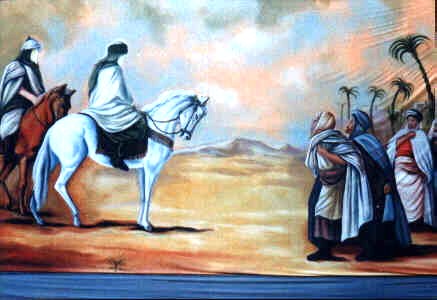
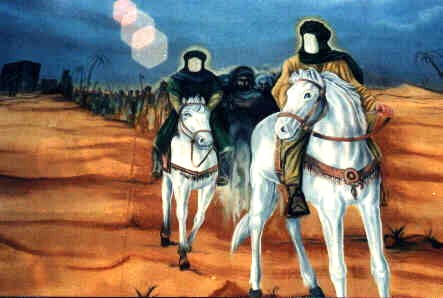
Aun and Muhammad were quite young. It is reported that Aun was about thirteen and Muhammad was a year or two younger. They had learnt the art of fencing from their uncle, Hazrat Abbas.
On the night before Ashura Bibi Zainab said to them, “My sons, tomorrow there will be a battle. I can not ask you to fight because you are young. But if anything happens to Imaam Hussain, while you are still alive, I will be filled with shame.” Both the boys stood up and said “Mother, we have the blood of Ali and Jaffer in our veins. Our grand fathers were warriors whose fame will always be remembered. Do you think we can possibly shame them? More over we are the pupils of Uncle Abbas. Mother, unless you forbid us and stop us from fighting, we shall go to the battlefield and show the enemies of Islam how bravely the children of Islam can fight. All we want from you is a promise that you will never weep for us. Or souls will never rest in peace if you grieve for us after we are gone“.
Tears of joy and pride flowed down Bibi Zainab’s eyes as she embraced her two boys. In the morning during the general attacks from the enemy, Aun and Muhammad fought side by side with Ali Akber, Qasim and Hazrat Abbas. Every time either of them succeeded in felling an enemy, he would look proudly at Hazrat Abbas who would smile and nod his approval. Imaam Hussain would not, however, give the two boys permission to go for single combat. They were very disappointed. They came to their mother for help. Bibi Zainab sent someone to request Imaam Hussain to come to her tent., When the Imaam came Bibi Zainab said, “Hussain, at the battle of Siffeen Abbas was only eight years old. When he saw someone trying to attack you, he rushed into the battle field and killed the man. Do you remember how proud our father Ali was? Today I too want to be proud of my sons. I want to see them go out there and defend Islam. Will you not allow me that privilege?” Imaam Hussain stood there in silence. He looked at his sister. He saw the disappointment on her face. He saw tears forming around her eyes. He put his arms around the two boys and led them to their horses. He kissed them and then helped them mount. “Go,” said Imaam, “Go, and show the world how those as young as you can fight the injustice and oppression of Yazid!” Then he turned round and lifted the curtain of the tent. The boys raised their hands and said “Fi Amaani-llah, mother!” Bibi Zainab replied, “Bismillah my sons. Allah be with you!“
The two boys rode out into the battlefield. They fought bravely. At one point Umar Sa’ad asked, “Who are these two youngsters? They fight like I have seen Ali ibne Abu Taalib fight.” When he was told who they were he ordered his soldiers to give up single combats and surround and kill the boys. Aun and Muhammad were attacked from all sides. Soon they were over-powered and brutally killed. Imaam Hussain and Hazrat Abbas carried the two young bodies to a tent and laid them on the floor. Imaam walked to Bibi Zainab’s tent. He found her in sijdah praying, “Ya Allah, I thank you for accepting my sacrifice. My heart is filled with pride because my two sons have given their lives for your religion.”
Reference: “The Journey of Tears” by Marhum Mulla Bashir Rahim [http://www.al-islam.org/journey-of-tears]
He continued: “Zainab! My sister! Falsehood can buy many supporters, but truth has only a few friends. The soldiers on the other side have been bought. They prefer happiness in this world than in the world hereafter. My 72 truthful men prefer happiness in the world hereafter and that is why they are with me.“
That night, Imam Husayn wrote a letter to his childhood friend, Habib lbne Mazaahir, who was in Kufa.
Kufa was blocked off and nobody was allowed to leave.
Habib Ibne Mazaahir did not know the whereabouts of Imam Husayn until the letter from Husayn arrived at his house. At the time he was having breakfast with his wife and a young son. Habib read the letter from Husayn. He kissed it and tears began to flow from his eyes. His wife asked him what was wrong. Habib said: “I have received a letter from my master, Husayn. He has asked me to join him in Kerbala. Yazid’s soldiers have surrounded him and are after his life.“
Habib’s wife said: “Habib! Your childhood friend has called you. Your master needs your help. What are you waiting for? Go Habib, before it is too late!“
Habib’s worry was how to escape from Kufa without being seen. He instructed his slave to take his horse to a farm outside the city and to wait for him there. The slave did as he was told. The slave took Habib’s horse to a farm outside the city. He waited for his master. His master was delayed.
The slave started talking to the horse: “O horse! Master Husayn is in trouble. He needs help. He has asked my master Habib to join him. Master Habib is late. Horse If he does not manage to escape from Kufa, I will ride on you and go to Husayn’s help.”
At Asr time, most of the men were in mosque. Habib managed to reach the farm where his horse was waiting.
He quickly mounted his horse and said to his slave: “Go, my friend, Go! I am freeing you from my services“
“Master! You are not being fair. I have served you faithfully for years. Now, I have a chance to serve the son of Bibi Fatemah, and you are asking me to go. Why are you denying me a place in Heaven’?”
Habib was taken aback by the words of his slave. He was pleased to hear that he had recognised the difference between the truth and the wrongful. He wanted to sacrifice his life for truth. Habib asked his slave to mount his horse. Together they galloped towards Kerbala. Habib reached Kerbala late in the evening. Imam Husayn greeted him with great affection.
Bibi Zainab heard that Habib had come. She asked her maid, Fizza, to convey her greetings to Habib.
When Habib heard that Bibi Zainab had sent greetings to him, he screamed out in grief and anger. He threw his turban down on to the ground. He slapped his face. Tears rolled down his cheeks as he spoke: “What a sad day! What has happened to the household of Bibi Fatemah? The princess! Grand-daughter of the Holy prophet, the daughter of Ali and Fatemah is sending her greetings to an ordinary person like me! Yazid! You beast, you tyrant! What have you done to the household of Bibi Fatemah?”
Days and nights of Moharram passed by, and Ashura came.
At dawn, Ali Akber gave Adhan for the last time. Yazid’s soldiers blew the trumpets to start the battle. One-by-one, Husayn’s companions went to the battlefield and gave their lives for Islam. Between Zohr and Asr time, Habib lbne Mazaahir came to Husayn. He said: “My Master, Husayn, allow me to go to the battlefield. Let me sacrifice my life for Islam.“
“Habib, my childhood friend. Stay with me. You give comfort to me, my friend.”
Habib persisted with his request. Eventually Husayn gave his permission. Husayn mounted his friend, Habib, on the horse. Habib lbne Mazaahir rode into the battlefield. He fought bravely but was finally over-powered. He fell to the ground. As Habib ibne Mazaahir fell to the ground, an enemy soldier came over and cut off his head. All the marytrs of Kerbala had their heads cut off, but Habib’s was the first to be cut off by the enemy. Habib’s head was not hung on the spearhead like that of the other martyr’s. Habib’s head was tied to a horse and pulled along the land of Kerbala.
Later on, in Shaam, Habib’s head was tied to a horse’s neck. A young boy, called Qasim, followed the horse wherever it went. One day, the man riding the horse asked the young boy Qasim: “Why are you following me around? What do you want? Qasim just looked at the head hanging from the horse’s neck. The man asked again: “Why are you staring at the head“.
“This head is the head of my father, Habib ibne Mazaahir; please give it to me so that I can bury my father’s head.” Habib’s head seemed to look at his son and say: “My son Qasim, you are thinking of burying my head. What about the head of Husayn on that spearhead?“
Al-Hurr left him and stood by the others. Beside him stood Qarrah Ibn Qays whom he asked, “Have you watered your horse today?” “No,” came the answer. “Do you then wish to do so?” was al-Hurr’s question. Qarrah took that statement to imply that al-Hurr was reluctant to fight al-Husain (A) and did not wish to be seen by him defecting, so he walked away from him. Al-Hurr kept getting closer and closer to al-Husain (A). Al-Muhajir Ibn Aws asked him, “Do you want to charge at him?”
Al-Hurr remained silent. He felt chilled to the bones, so he shivered. Having seen him shiver, al-Muhajir felt terrified and said to him, “Had I been asked: ‘Who is the most daring of all the Kufians?’, I would have given no name other than yours; so, why do I see you look like that?” Al-Hurr said, “I am giving my soul the option between choosing Paradise or hell. By Allah! I do not prefer anything over Paradise even if it means I will be burnt alive.” Having said so, he beat his horse in the direction of al-Husain (A).[583]
Turning his spear upside down and holding his shield the opposite way, he came lowering his head, feeling too shy to look at the Prophet’s family in the eyes because of having exposed them to such hardship, bringing them to such a place where neither water nor grass could be found. Loudly he spoke these words:
“O Allah! To You do I surrender, so do accept my repentance, for I have filled the hearts of Your walis and the sons of Your Prophet with fear! O father of ‘Abdullah! I am repentant; so, can my repentance be accepted at all?”
Al-Husain (A) said, “Yes. Allah will accept your repentance”. This statement found its place to al-Hurr’s heart, filling it with joy. He took a moment to contemplate upon the eternal life and the incessant bliss. It now became clear to him what that voice, which had addressed him, meant upon his departure from Kufa. He had a dialogue with al-Husain (A). Among what he said to him was:
“When I went out of Kufa, I was addressed thus: “O Hurr! You are given the glad tidings of [going to] Paradise!” I said to myself, “Woe unto me! How can I be given such glad tidings since I am going to fight the son of the daughter of Allah’s Messenger?!” [585]
Al-Husain (A) said to him, “You have now acquired a great deal of good and a great reward.” [586] A Turkish slave was with him. [587]
al-Hurr admonishes the Kufans
Al-Hurr sought al-Husain’s permission to address the people, and permission was granted to him. As loudly as he could, al-Hurr called out to the Kufians thus:
“O people of Kufa! A foolish and a bad example for others have you surely set when you invited him to come to you then grieved him and surrounded him from all directions, forbidding him from going anywhere in Allah’s spacious land so that he and his family might be safe, rendering him like a captive in your hands, unable to help himself. You have prohibited him, his ladies, his children, and his companions from the flowing water of the Euphrates of which the Jews, the Christians, and the Zoroastrians drink and wherein black swine and dogs wade! Look and see how thirst has subdued them! Evil is the way whereby you have succeeded Muhammad (S) in treating his progeny! May Allah never permit you to drink on the Day of Thirst!”
His own men now started shooting him with arrows, so he was forced to retreat till he stood face-to-face with Imam Husain (A). [588]
After the martydom of Habib, al-Hurr Ibn Yazid al-Riyai came out accompanied by Zuhayr Ibn al-Qayn who was protecting him from the rear. Whenever one of them attacked and the situation became critical, the other would attack to rescue him, and they kept doing so for a while. [618] The horse on which al-Hurr was riding received hits on its ears and eyebrows, and it was bleeding as its rider was quoting the following verse by Antar Ibn Shaddad al-’Abasi:
I kept shooting them at its very mouth, At its chest, till blood drenched it all.
Al-Hasin said to Yazid Ibn Sufyan, “Is this al-Hurr whom you wished to kill?” “Yes,” said Yazid, so the first came out and challenged al-Hurr to a duel. It turned out that al-Hasin was asking for a swift death, for it did not take al-Hurr long to kill him! Ayyub Ibn Mashrah al-Khaywani shot al-Hurr’s horse with an arrow, hamstringing it. The poor horse leaped, so the rider leaped from it like a lion, [619] holding his sword in his hand. He kept fighting on foot till he killed more than forty men. [620]
A company from the footmen fiercely attacked him and killed him. Al-Husain’s companions carried his body and put it before the tent in front of which they were fighting. They were doing so whenever a man was killed, and al-Husain (A), each time, kept repeating this statement: “He has been killed as prophets and the offspring of prophets are killed.” [621]
Al-Husain (A) turned to al-Hurr, who was breathing his last, and said to him, as he wiped out the blood from his face, “You are al-Hurr [which means: the free man], just as your mother named you, and you are free in this life and in the life hereafter.” One of the companions of al-Husain (A), who some say was [al-Husain (A)’s son] ‘Ali Ibn al-Husain, [622] eulogized him with the following verses which some people claim the Imam (A) himself had composed: [623]
How good al-Hurr of Banu Riya! How patient when the lances intertwined! How good al-Hurr when he defended Husain! And in the morning his life he sacrificed!
To be continued…
Reference:
Maqtal al-Husain: Martrydom Epic of Imam al-Husain (A) by ‘Abd al Razzaq al-Muqarram Published by: Al-Kharsan Foundation for Publications, Beirut, Lebanon, 1426 AH/2005 AD
Notes:
[583] al-Tabari, Tarikh, Vol. 6, p. 244.
[585] Ibn Nama, Al-Luhuf, p. 58. as-Saduq, Al-Amali, p. 97, majlis 30. ‘Ali Ibn Muhammad al-Fattal al-Naishapuri, Rawat al-Wa’iin, p. 159.
[586] Ibid.
[587] Ibn Nama, Muthir al-Azan, p. 31. On p. 9, Vol. 2, of his book Maqtal al-Husain, al-Khawarizmi says that he [al-Hurr] had a Turkish slave with him.
[588] Ibn al-Athir, Vol. 4, p. 27.
[618] al-Tabari, Tarikh, Vol. 6, p. 252. Al-Bidaya, Vol. 8, p. 183.
[619] al-Tabari, Tarikh, Vol. 6, pp. 248 and 250.
[620] Ibn Shahr Ashub, Manaqib, Vol. 2, p. 217 (Iranian edition).
[621] This text is quoted from p. 118 of Taallum al-Zahra’ of Raiyy ad-Din al-Qazwini, from p. 135, Vol. 13, of al-Nu’mani’s Ghayba. According to p. 256, Vol. 6, of al-Tabari’s Tarikh and p. 30, Vol. 4, of Ibn al-Athir’s book, as well as al-Mufid’s book Al-Irshad, a tent was placed on the battlefield, but these authors did not mention al-Husain (‘a) by name due to the magnanimity of the situation.
[622] ’Abdullah Nur-Allah al-Bahrani, Maqtal al-’Awalim, p. 85. al-Khawarizmi, Maqtal al-Husain, Vol. 2, p. 11.
[623] ’Ali Ibn Muhammad al-Fattal al-Naishapuri, Rawat al-Wa’iin, p. 160. as-Saduq, Al-Amali, p. 97, majlis 30.
“Our affair has reached the point which you can see. Life has changed and turned against us. Its goodness has abandoned us, leaving nothing but a trickle like a pot dripping and a life of hardship like an afflicted pasture. Do you not see how righteousness is not upheld and how falsehood is not shunned? Let every believer desire the meeting with Allah I see death as nothing but a source of happiness while living with the oppressors as sure displeasure”. [66]
Zuhayr stood up and said, “We have heard your statement, O son of the Messenger of Allah! Had life been secured for us forever, we would still have preferred to rise with you rather than remain therein.”
Burayr stood up and said, “O son of the Messenger of Allah! Allah has blessed us with your company so that we may fight defending you till our parts are cut off for your sake, then your grandfather will intercede on our behalf on the Day of Judgment.” [67]
Nafi’ Ibn Hilal said, “You know that your grandfather the Messenger of Allah (S), could not instill his love in the heart of people nor make them obey him and do what he liked them to do, and there were many hypocrites among them who promised to support him while hiding their treacherous intentions against him. They would meet him and speak to him words sweeter than honey then depart from him with those more bitter than colocynth till Allah took his soul away. Your father ‘Ali underwent the same. There were folks who were unanimous in supporting and fighting with him against those who broke their promises, who regarded themselves as more fair than him, and who abandoned the creed altogether, till he met his fate. He went to a mercy from Allah and pleasure. Today, you are with us in the same situation: there are those who reneged from their promise of support and who abandoned their oath of loyalty. These shall not harm except their own selves, and Allah shall suffice you for them; so, march with us, being rightly guided and in good health, be it to the east of the earth or to the west. By Allah, we are not too scared to meet Allah’s destiny, nor do we hate to meet our Lord. We are determined to befriend whoever befriends you and be the enemy of whoever antagonizes you.” [68]
Al-Husain (A) bought the lots where his grave now stands from the residents of Nineva and al-Ghadiriyya for sixty thousand dirhams. He then turned and gave it back to them as charity on one condition: they lead people to his gravesite and host whoever visited it for three days. Al-Husain’s sanctuary, which he bought, was four miles long by four miles wide. It is lawful for his offspring and those loyal to him and is prohibited from those who oppose them. It is full of bliss. Imam as-Sadiq (A) has said that those people did not fulfill that condition. [69]
When al-Husain (‘a) camped at Karbala’, he wrote Ibn al-Hanafiyya and a group from Banu Hashim saying, “It is as if this life has never been, and as if the hereafter has always been, and peace be with you.” [70]
To be continued…
Reference:
Maqtal al-Husain: Martrydom Epic of Imam al-Husain (A) by ‘Abd al Razzaq al-Muqarram Published by: Al-Kharsan Foundation for Publications, Beirut, Lebanon, 1426 AH/2005 AD
Notes:
[64] This date is provided by al-Tabari on p. 233, Vol. 6, of his Tarikh, by Ibn al-Athir on p. 20, Vol. 4, of his book Al-Kamil, and by al-Mufid in his book Al-Irshad.
[65] al-Majlisi, Bihar al-Anwar, Vol. 10, p. 198. Al-Khawarizmi, Maqtal al-Husain, Vol. 1, p. 237.
[66] This text is recorded in Al-Luhuf by Ibn Tawus. Al-al-Tabari, on p. 229, Vol. 6, of his Tarikh, says that al-Husain (‘a) had delivered this speech at Thu Hasm.
[67] Ibn Tawus, Al-Luhuf, p. 44.
[68] al-Bahrani, Maqtal al-’Awalim, p. 76.
[69] Shaikh al-Baha’i, Kashkool, Vol. 2, p. 91 (Egyptian edition), quoting Kitab al-Ziyarat by Muhammad Ibn Ahmad Ibn Dawud al-Qummi.
[70] Ibn Qawlawayh, Kamil al-Ziyarat, p. 75, Chapter 23. Abul-Faraj al-Ishfahani, on p. 151, Vol. 8, of his book Al-Aghani (Sasi edition), says that al-Hasan al-Basri wrote ‘Umar Ibn ‘Abd al-’Aziz about that when the latter became caliph. According to Muruj al-Thahab, ‘Umar Ibn ‘Abd al-’Aziz wrote Abu Hazim al-Madani al-A’raj saying, “Admonish me, and be brief,” so he wrote him back stating the above.
Soon, al-Hurr al-Riyai [30] came to them face-to-face escorted by a thousand cavaliers. He was dispatched by [‘Ubaydullah] Ibn Ziyad in order to prohibit al-Husain (A) from going back to Medina, to arrest him, and to bring him to Kufa. It was a very hot midday when al-Hurr and his men confronted al-Husain (A). [31]
When the Master of Martyrs (A) saw how thirsty that band was, he ordered his followers to serve water to them and to their horses. They gave each and every one of them water, then they filled water pots and brought them near the horses each one of which drank three to five times of them till they all drank to their fill. [32]
‘Ali Ibn al-i’an al-Muaribi was in al-Hurr’s company. He happened to be the last to be served, so he was suffering acutely of the pangs of thirst. In his Hijazi accent, al-Husain (A) said to him, “Ankhi al-rawiya,” but the man did not understand what he (A) meant. The Imam (A), therefore, repeated his statement, this time using classical Arabic: “Ankhil-jamal.” When the man tried to drink, he caused the water to run wastefully out of the water-bag, so the Fragrant Flower of the Messenger of Allah (S) now said to him, “Ankhi al-siqa,” but the poor man did not know exactly what to do due to his inability to think because, again, of the thirst from which he was severely suffering. This time the Imam (A) stood up and adjusted the water-bag for that man in person till he drank enough, then he (A) watered his horse as well. Such is the kindness and compassion of the most Oppressed One towards that band that met in a desert where each drop of water was as precious as life itself. Surely he was fully aware of the situation being so precarious, knowledgeable of the consequences should water run out the next day, knowing that it could be the sole cause of death. But the Prophet’s blood that ran in his veins, and the exemplary generosity of his father ‘Ali (A), did not leave him any choice.
O son of al-Zahra’, heart of ‘Ali the valiant, O soul of the guiding Prophet! Strange how these people did not Come to you to sacrifice themselves for you; But they did not value your precious soul: How can dust be compared with the mountain? How wondrous to see Allah’s Clemency When they, as He watched, violated your sanctity! How strange, the favourites of Allah became For Yazid and for Ziyad a booty to claim!
Then al-Husain (A) welcomed them. He praised Allah and glorified Him then said:
“This is to seek pardon of Allah, the most Exalted One, the most Mighty, and of your own selves: I did not come to you except after having received your letters which your messengers delivered to me, requesting me to come to you, saying, “We have no Imam, so come to us, perhaps Allah will gather all of us under the shade of His guidance.” So if the case is as such, then I have come to you; therefore, provide me with that whereby I can trust your promises and covenants. But if you hate my arrival, then I shall leave you and go to where I had come from.”
The men did not utter one word. Al-Hajjaj Ibn Masruq al-Ju’fi called the athan for the noon prayers. It was then that al-Husain (A) asked al-Hurr, “Would you like to lead your men for the prayers?” He answered: “No. Rather, we will all pray behind you.” The Imam (A) led the prayers.
Having finished the prayers, the Imam (A) faced them, praised and glorified Allah and blessed Prophet Muhammad (S) then said,
“O people! If you fear Allah and wish to get to know who follows righteousness, it will please Allah better. We, the family of Muhammad (S), are more worthy of you in shouldering the responsibility of authority, more so than these who lay a claim to what does not belong to them, whose tradition is oppression and transgression. If you insist on hating us and ignoring our right, and if your view now is different from what your letters to me described, then I will part from you.”
Al-Hurr said, “I do not know what letters you are talking about.” Al-Husain (A) immediately ordered ‘Uqbah Ibn Sam’an to bring out two saddlebags full of letters. Al-Hurr said, “I am not among their senders, and I have been ordered not to part with you once I meet you till I bring you to Ibn Ziyad in Kufa.” Imam al-Husain (A) said, “Death is closer to your reach than that.” He ordered his companions to ride, and the women, too, rode, but al-Hurr forbade them from going to Medina, so al-Husain (A) said to al-Hurr, “May your mother lose you! What do you want of us?” “Should anyone else other than you say so to me,” al-Hurr responded, “and he is in the same boat as you now are, I would not hesitate to let his mother lose him no matter who he may be! By Allah! I have no way to refer to your mother except in the very best of way of which we are capable. But let us come to a mid-way between both of us which neither leads you to Kufa nor takes you back to Medina till I write Ibn Ziyad, perhaps Allah will grant me safety and not try me with anything relevant to your issue.” After a short while he added saying, “I admonish you to remember Allah with regard to your life, for I testify that should you fight, you will be killed.” Al-Husain (A) said, “Are you scaring me with death?! Will your calamity really lead you to kill me? In that case, let me say what the brother of the Aws [tribe] said to his cousin who desired to support the Messenger of Allah, peace of Allah be upon him and his Progeny: [33]
I shall proceed: There is no shame A man to his death goes. If he truly intends so and As a Muslim struggles, And if he the righteous with his life consoles, Leaving a depraved one, opposing a criminal. So if I live, I shall not regret or be shamed But if I die, surely I shall not be blamed Humiliation suffices you if you accept to be oppressed.”
Having heard him say so, al-Hurr stayed away from him. Al-Husain (A), therefore, rode with his companions in one area while al-Hurr and his fellows rode in another. [34]
al-Baydha
At al-Baydha [35], the Imam (A) delivered a speech to al-Hurr’s companions after having praised and glorified Allah In it he said,
“O people! The Messenger of Allah (S) has said, “If one sees an oppressive ruler, who makes lawful what Allah has made unlawful, and he does not get him to alter his conduct through something he does or says, it will be incumbent upon Allah to resurrect him in that ruler’s company. These folks have upheld Satan and abandoned their obedience to the most Merciful One, demonstrating corruption and making mischief evident. They idled the limits (set forth by Allah) and took to their own selves what belonged to others, prohibiting what Allah has permitted and permitting what He has prohibited. I am the best suitable person to change the situation. Your letters reached me, and so did some of your messengers who brought me your oath not to hand me over [to my foes] nor to betray me. If you, therefore, complete the terms of your oath of allegiance, you will achieve the right guidance, for I am al-Husain son of ‘Ali and Fatima daughter of the Messenger of Allah (S). My soul is with yours, my family is with your families, and you have in me a model of conduct. But if you do not, and if you violate your promise and renege in your oath of allegiance to me, then, by my life, it will not be the first time that you do so: you did so to my father, to my brother [Imam al-Hasan (A)], and to my cousin Muslim. Deceived is whoever trusts you. Surely it is to the detriment of your own luck that you thus err, rendering your lot a loss. Whoever reneges, he, indeed, reneges against his own soul, and Allah shall suffice me for you, and peace be with you and the mercy and blessings of Allah”. [36]
al-Ruhayma
At al-Ruhayma [37], a Kufian named Abu Haram met the Imam (A) and said to him, “O son of the Messenger of Allah! What made you leave the sanctuary of your grandfather?” The Imam (A) said, “O Abu Haram! Banu Umayyah taunted my honour, and I took to patience. And they confiscated my wealth, and I again took to patience. Then they sought to kill me, so I fled. By Allah! They will kill me. Allah will then cover them with an overwhelming humiliation and with a sharp sword which He will place over their heads, a word that will abase them [38] till they become more abased than the people of Saba’ (Sheba) who were ruled by a woman over their wealth and their lives.” [39]
al-Qadisiyya
At al-Qadisiyya, al-Hasin Ibn Namir al-Tamimi arrested Qays Ibn Mishir al-Saydawi, al-Husain’s messenger to the people of Kufa. Al-Hasin had been ordered by Ibn Ziyad to station cavaliers to guard the area between Khafan and Qaqaana [40]. When he wanted to search the messenger, the latter took the letter out and shredded it. He was brought to Ibn Ziyad who asked him why he had shredded the letter. He told Ibn Ziyad that he did so in order that they would not know what it contained. But Ibn Ziyad insisted that he should tell him about its contents. Qays refused, whereupon Ibn Ziyad said to him, “Ascend the pulpit and curse al-Husain and his father and brother; otherwise, I will cut you to pieces.”
Qays ascended the pulpit, praised and glorified Allah and blessed the Prophet (S) and his Progeny (A) and was profuse in imploring Allah’s blessings on the Commander of the Faithful (A) and on al-Hasan and al-Husain (A). Moreover, he cursed ‘Ubaydullah Ibn Ziyad and his father and all Banu Umayyah, then he said, “O people! I am the messenger of al-Husain (A) to you! I have left him in such-and-such a place; so, you should rush to his aid.” Ibn Ziyad ordered him to be thrown from his mansion’s rooftop. He was thrown; his bones were crushed, and he died [41]. Some accounts say that he did not die immediately, so ‘Abd al-Malik Ibn ‘Umayr al-Lakhmi slit his throat [as stated above]. When he was blamed for doing so, he said, “I only wanted to put an end to his suffering.”[42]
al-Utahyb
At ‘Uthayb al-Hajanat [43], al-Husain (A) met four men who were leaving Kufa on camel-back, taking with them “al-Kamil,” a horse belonging to a man called Nafi’ Ibn Hilal. They were: ‘Amr Ibn Khalid al-Saydawi, his slave Sa’d, Majma’ Ibn ‘Abdullah al-Mathaji, and Nafi’ Ibn Hilal. Their guide, al-Tarmah Ibn ‘Adiyy al-Ta’i, was chanting the following verses:
O my she-camel! Do not complain of my impatience, And set out just before the sun rises, So we may join the best of riders and embark Upon the best journey till we reach One beautified with the best of descent, The munificent, the free, the open-hearted one Whom Allah brought for the best of affair: May He preserve him as He preserves time!
When they reached al-Husain, peace be upon him, they chanted those verses for him, so he (A) said, “By Allah! I hope what Allah fares with us will be good, whether we are killed, or whether we win victory.”
Al-Husain (A) asked them about the public opinion. They said, “Prominent personalities have received great bribes; people’s hearts are with you, while the swords are turned against you.” They informed him of Qays Ibn Mishir al-Saydawi having been killed, so he, peace be upon him, quoted the Qur’anic verse saying,
“… of them is he who accomplished his vow, and of them is he who awaits” (Qur’an, 33:23).
“O Allah!” he added, “Make Paradise our home and theirs, and include us and them in Your mercy and in all what is desired of Your treasured rewards.”
Al-Tarmah has said, “I saw people before my departure from Kufa meeting outside. I asked them about it, and they said to me, ‘They are being paraded, then shall they be sent away to fight al-Husain.’ I, therefore, plead to you in the Name of Allah not to go to fight them, for I see none aiding you. If only this group fights you, the same one I see watching you, they will suffice to put an end to you. Come with us in order to settle at our mountain, ‘Aja. It protected us from the kings of Ghassan and imyar, from al-Nu’man Ibn al-Munthir, and from al-Aswad and al-Amar. By Allah, after no more than ten days, Tay’s men will come to your aid riding or on foot. I guarantee you twenty thousand men from Tay who will defend you with their swords till it becomes clear to you what you wish to do.”
Al-Husain (A) prayed Allah to reward him and his people with goodness then said, “A covenant binds us to the people, and we cannot depart till destiny deals between us and them.” Al-Tarmah then asked his permission to get provisions to reach his own family, promising that he would hurry back to support him. He granted him permission as others accompanied him.
Al-Tarmah delivered the provisions to his people then quickly returned. Having reached ‘Uthayb al-Hajanat, he came to know that al-Husain, peace be upon him, had been killed, so he went back. [44]
Qasr Bani Muqatil
A-Husain (A) marched from ‘Uthayb al-Hajanat till he reached Qasr Bani Muqatil [45]. There, he saw a tent, a lance planted in the ground, and a mare waiting. He inquired about them and was told that they belonged to ‘Ubaydullah Ibn al-Hurr al-Ju’fi [46]. Al-Husain (A) sent him al-Hajjaj Ibn Masruq al-Ju’fi as his messenger. Ibn al-Hurr asked him what he wanted. He said, “I have a gift for you and I have esteem, if you only accept. Al-Husain (A) invites you to support him. If you fight for him, you will be rewarded, and if you get killed, you will be a martyr.” Ibn al-Hurr said, “By Allah! I did not leave Kufa except on account of the large number of people whom I saw going out to fight him, and on account of his own Shi’as betraying him; so I realized that he was certainly going to be killed and that I am unable to do much for him; I do not like him to see me, nor do I like to see him.” [47]
Al-Hajjaj relayed what he had heard to al-Husain (A) who stood up and, accompanied by a number of his family members and companions, entered al-Hurr’s tent. The latter seated the Imam (A) in the middle. Ibn al-Hurr himself narrated later saying, “I never saw in my life anyone better looking or greater than al-Husain, nor did I ever feel sorry for anyone as much as I felt sorry for him when I saw him walking surrounded by very young men. I looked at his beard and found it as dark as a raven’s wing, so I asked him whether it was naturally black or whether he had dyed it. He said to me, ‘O Ibn al-Hurr! Gray hair hastened to me,’ so I realized that he had dyed it.” [48]
Having settled there, Abu ‘Abdullah (A) praised Allah and glorified Him then said, “O Ibn al-Hurr! Your countrymen wrote me saying that they were unanimous in supporting me. They asked me to go to them, but it seems it is not as they claimed [49].
You have committed a great many sins; so, would you like to seek repentance whereby you wipe out your sins?” He said, “And how is that, O son of the Messenger of Allah?” Al-Husain (A) said, “You should support the son of your Prophet’s daughter and fight on his side.” [50]
Ibn al-Hurr said, “By Allah! I know that whoever supports you will be happy in the hereafter, but how much help can I afford you, having left in Kufa none to support you? I, therefore, plead to you in the Name of Allah to agree to this plan of mine, for I hate to die! My mare, al-Muliqa, is such that I never pursued anything except that it caught up with it, nor did anyone pursue me except that I outran him. Take her; she is yours.” Al-Husain (A) said, “Should you prefer your own safety over supporting our cause, we have no need for your mare nor for you[51]:
‘You should not take those who mislead others for friends’ (Qur’an, 18:51) [52].
I advise you just as you advised me that if you can, do not hear our cries, nor should you witness our battle, for by Allah, whoever hears our mourners and refuses to come to our rescue will be hurled by Allah into the fire of hell headlong.” [53]
Ibn al-Hurr regretted having lost the opportunity to support al-Husain (A), so he composed the following poetic lines:
So long as I live, so shall my sigh Reverberating between my chest and my choke When he did say to me at the mansion: “Should you really leave us and from us depart?” Husain in humility seeks my support Against the people of enmity and dissension. Should sighing cleave a freeman’s chest, My heart would now be cleft. Had I defended him with my life I would have earned mercy on the Day of Meeting. Had I fought beside Muhammad’s son, may I For him sacrifice my life; So bid farewell and hurry to set out, Surely winners are those who support Husain, While deeds of others, the hypocrites, will be in vain.
At the same place, ‘Amr Ibn Qays al-Mashfari and his cousin met al-Husain (A) who asked them whether they had met him in order to support him. They said to him, “We have a large number of dependents and we have many items which belong to others. We do not know what will happen, and we hate not to give people back what they had entrusted to us.” He, peace be upon him, said to them, “Go, and do not hear our women mourn, nor should you see us wearing black, for whoever hears our women wailing or sees our black without supporting us, it will be incumbent upon Allah, the most Exalted, the most Great, to hurl him in hellfire headlong.” [54]
The Taff Villages
When the night came to a close, the Imam (A) ordered his servants to fill their water bags and to leave Qar Bani Muqatil. On their way, al-Husain (A) was heard repeating: Inna lillah wa inna ilayhi rajia’un, wal hamdu lillahi rabbil ‘a lamin… (We belong to Allah and to Him shall we return, and all Praise belongs to Allah, the Lord of the worlds).
His son, ‘Ali al-Akbar, heard him and asked about the reason which prompted him to keep repeating these statements. Said the Imam (A), “I drowsed for a moment, whereupon I saw a horseman saying, ‘These people are marching as fates march towards them,’ so I realized that we are being eulogized.” “May Allah never permit you to see any evil,” said ‘Ali al-Akbar, “Are we not right?” “We are, by the One to Whom all the servants shall return,” al-Husain (A) answered. “O father! In that case, we do not mind at all having to die so long as we are right,” said ‘Ali. Al-Husain (A) said, “May Allah reward you for being such a good son with the best of rewards whereby He rewards a son on behalf of his father.” [55]
Al-Husain (A) kept marching till he arrived at Nineva [56].
There, an armed man riding a camel was seen coming in their direction. They waited for him. He turned out to be a messenger sent by Ibn Ziyad to al-Hurr carrying a letter wherein he was ordering al-Hurr to be rough in treating al-Husain (A) and not to permit him to set up his camp anywhere other than in the wilderness where there was neither access to water nor any natural fortifications.
Such was the letter which al-Hurr himself had read to al-Husain (A) who said to him, “Let us camp at Nineva, or al-Ghadiriyya, or Shfayya.” “I cannot do that,” said al-Hurr, “for the man [governor] has already assigned men to spy on me.” [57]
Zuhayr Ibn al-Qayn said, “O son of the Messenger of Allah! Fighting this band is easier for us than fighting those who will come after them. By my life! Armies will come to us which our eyes had never seen before.” Al-Husain (A) said to him, “I shall not be the one who fights them first.” Then Zuhayr said, “There is a village nearby at the bank of the Euphrates; it is defensible and it overlooks the Euphrates from all but one direction.” Al-Husain (A) asked him about its name, and when he came to know that it was called “al-’Aqr,” [58] [which means in Arabic “hamstringing”], the Imam (A) said, “We seek refuge with Allah against hamstringing.”
Al-Husain (A) then turned to al-Hurr and asked him to keep on marching further.
They all marched till they reached an area called Karbala’. There, al-Hurr and his company stopped in front of al-Husain (A), forbidding him from going any further, saying, “This place is near the Euphrates.” It is said that as they were marching, al-Husain’s horse stopped and refused to move just as Allah had caused the she-camel of the Prophet (S) to stop at the Hudaibiya [59]. It was then that al-Husain (A) inquired about the name of that place. Zuhayr said to him, “Keep on marching and do not ask about anything till Allah brings us ease. This land is called al-Taff.” He, peace be upon him, asked him whether it had any other name, so he told him that it was also called “Karbala’”. It was then that the Imam (A) started weeping [60]. He said, “O Allah! I seek refuge with You against the karb [affliction] and bala’ [trial and tribulation]! [61] Here shall we camp, and here will our blood be spilled and our graves be dug! My grandfather the Messenger of Allah (S) had told me so.” [62]
By Allah! Never shall I forget, even if all do, How his charging mare stood at al-Taff, O mare of his! Did the hand of fate tie you So you stood and refused to budge? You used to be faster than a cloud’s lightning; Calamity descends whether you speed or not. Should you not have avoided the road and strayed From that valley to the wide expanse? How did you take him to perdition, may you Lose your father, how dared you? Why did you not refuse, why? O what a great stand when Those throngs did gather and stand! A great stand that shook the foundations Of Allah’s ‘Arsh a great shaking, So shall Yazid stand One Day When it will be said to Ahmad: “Stand up and intercede!” A stand, it was, followed by a fall That gave us a drink hard to take A stand, it was, that caused Muhammad’s progeny To always grieve till the Pretender, for eternity.[63]
To be continued…
Reference:
Maqtal al-Husain: Martrydom Epic of Imam al-Husain (A) by ‘Abd al Razzaq al-Muqarram Published by: Al-Kharsan Foundation for Publications, Beirut, Lebanon, 1426 AH/2005 AD
Notes:
[28] Mu’jam al-Buldan tells us that it is named after a man bearing this name who had dug a well there followed by many large and plentiful wells of sweet water. According to p. 87, Vol. 4, of al-Tabari’s Tarikh, when Sa’d Ibn Abu Waqqass was at Sharaf, al-Ash’ath Ibn Qays joined him with a hundred Yemenites. He left the throngs of men at Sharaf and took to Iraq.
[29] It is named after a mountain where al-Nu’man Ibn al-Munthir used to hunt, and al-Thubyani, the genius poet, composed poetry about it.
[30] According to p. 215 of Ibn Hazm’s book Jamharat Ansab al-’Arab, his full name is al-Hurr Ibn Yazid Ibn Najiyah Ibn Qa’nab Ibn ‘Atab al-Radf Ibn al-Harmi Ibn Riya Yarbu’. ‘Atab is called “al-Radf” because kings used to ride with him. On p. 213 of the same reference, the name of Yarbu’ is provided as: Yarbu’ Ibn Hanzalah Ibn Malik Ibn Yazid-Manut Ibn Tamim.
[31] al-Khawarizmi, Maqtal al-Husain, Vol. 1, p. 230, Chapter 11.
[32] al-Tabari, Tarikh, Vol. 6, p. 226.
[33] The reference to his citing these verses has already been indicated above.
[34] al-Mufid, Irshad. On p. 193, Vol. 2, of his book Al-Manaqib, Ibn Shahr Ashub adds the following verses to them: My soul do I present, not sparing it, To meet a lion in the battle, a charging one.
[35] It is located between Waqia and ‘Uthayb al-Hajanat and is a spacious land inhabited by the offspring of Yarbu’ Ibn Hanzalah
[36] al-Tabari, Tarikh, Vol. 6, p. 229. Ibn al-Athir, Al-Kamil, Vol. 4, p. 21.
[37] According to Mu’jam al-Buldan, it is located about three miles from Khifya, and the latter is located westward more than ten miles from al-Raba.
[38] as-Saduq, Amali, p. 93, majlis 30.
[39] al-Khawarizmi, Maqtal al-Husain, Vol. 1, p. 226. Ibn Nama, Muthir al-Azan, where the entire hadith is cited.
[40] According to Vol. 3, p. 451, of Mu’jam al-Buldan, Khafan is a place near Kufa where there is a well near a village inhabited by the offspring of ‘Eisa Ibn Musa al-Hashimi. On p. 125, Vol. 7, al-Qaqaana is located more than twenty miles from Ruhayma.
[41] al-Mufid, Al-Irshad. al-Fattal, Rawat al-Waizin. Ibn Kathir, Al-Bidaya, Vol. 8, p. 118. al-Tabarsi, I’lam al-Wara, p. 136 (first Iranian edition). It is stated on p. 151, Vol. 1, of al-Thahbi’s book Mizan al-I’tidal, that Abd al-Malik Ibn ‘Umayr al-Lakhmi was made governor of Kufa after al-Sha’bi, but his memory was weak, and he was prone to err quite often. On p. 309, Vol. 1, of al-Nawawi’s book Thahthib al-Asma’, he died in 136 A.H./754 A.D. at the age of a hundred and three.
[43] Al-’Uthayb is a valley inhabited by Banu Tamim where a Persian garrison is [then and there] stationed. The distance between it and al-Qadisiyya is six miles. It was named so because the horses of al-Nu’man, king of ‘ira, used to graze there.
[44] al-Bukhari, Tarikh, Vol. 6, p. 230.
[45] “Qasr Muqatil” means: the castle of Muqatil, namely Maqatil Ibn Hassan Ibn Thu’labah who, according to Yaqut al-Hamawi’s Mu’jam al-Buldan, descended from Imri’ul-Qays Ibn Yazid Ibn Manat Ibn Tamim [the famous poet] . It is situated between ‘Ayn al-Tamr and al-Qaqaana. It was demolished by Eisa Ibn ‘Ali Ibn ‘Abdullah Ibn al-’Assbbas, then he rebuilt it.
[46] On p. 168, Vol. 7, of al-Tabari’s Tarikh, and also on p. 385 of Ibn Hazm’s book Ansab al-’Arab, it is stated that this man was a staunch follower of ‘Uthman [Ibn ‘Affan] ; this is why he went out to support Mu’awiyah against ‘Ali (‘a) in the Battle of Siffin.[47] al-Dinawari, Al-Akhbar al-Tiwal, p. 246.
[48] al-Adib al-Baghdadi, Khazanat al-Adab, Vol. 1, p. 298 (Bulaq, Egypt, edition). al-Balathiri, Ansab al-Ashraf, Vol. 5, p. 291.
[49] Shaikh ‘Abbas al-Qummi, Nafs al-Mahmum, p. 104.
[50] Sayyid Kaďim al-Ha’iri, Asrar al-Shahada, p. 233.
[51] al-Dinawari, Al-Akhbar al-Tiwal, p. 249.
[52] as-Saduq, Al-Amali, p. 94, majlis 30.
[53] Khizanat al-Adab, Vol. 1, p. 298.
[54] as-Saduq, ‘Iqab al-A’mal, p. 35. Al-Kashshi, Rijal, p. 74.
[55] al-Tabari, Tarikh, Vol. 6, p. 231. On p. 48 of Maqtal al-’Awalim (of ‘Abdullah Nur-Allah al-Bahrani), it is stated that “Al-Husain (‘a) took a nap in the after-noon at al-Uthayb. He saw in a vision someone saying, ‘You are speeding, yet death is speedily taking you to Paradise.’” According to p. 226, Vol. 1, of al-Khawarizmi’s book Maqtal al-Husain, al-Husain (‘a) reached al-Tha’labiyya where he slept in the after-noon. He woke up weeping. His son, ‘Ali al-Akbar, asked him why he was weeping. ‘Son! This is an hour in which no vision tells a lie! Just as I felt drowsiness overtaking me…, etc.’”
[56] According to Vol. 10, bound edition No. 7, dated 1330 A.H./1912 A.D., it was one of the Taff villages, a town full of scholars and scholarship. It reached its zenith during the time of Imam Ja’far as-Sadiq (‘a). At the beginning of the third century, it did not amount to anything.
[57] al-Mufid, Kitab al-Irshad.
[58] al-Ghadiriyya is named after Ghadira, a clan of Banu Asad. It is said to lie to the north of ‘Awn’s grave.
[60] Ibn Shadqam, Tufat al-Azhar (a manuscript). On p. 209, Vol. 3, of Siyar A’lam al-Nubala’, al-Thahbi writes saying that when al-Husain (‘a) asked which land it was, and when he was told it was called Karbala’, he said, “Karb (affliction) and bala’ (trial and tribulation).”
[61] al-Majlisi, Bihar al-Anwar, Vol. 10, p. 188.
[62] See Al-Luhuf of Ibn Tawus.
[63] Excerpted from a 93-line poem by Shaikh Muhammad Ibn Sharif Ibn Fala al-Kaďimi, the same poet who had composed the “Kerrari Poem” in praise of the Commander of the Faithful (‘a), one critiqued by as many as eighteen of his contemporary poets. Both poems are among the manuscripts at the library belonging to the authority critic al-Amine, author of the Al-Grader encyclopaedia.
Al-Husain (A) considered that caravan his own wealth that Allah Almighty put at his disposal on account of his being the Imam appointed by the Omnipotent, Praise to Him. Yazid and his father had already confiscated what belonged to him as well as what belonged to the Muslims, so it became mandatory on him to take control of the Muslims’ spoils to distribute to the needy among them. He, indeed, gave of it generously to the bedouins who accompanied him on the way and who complained to him of the pain of poverty from which they were suffering. But it was a destiny that the Master of the Youths of Paradise could not give what the oppressors had confiscated of Prophet Muhammad’s nation back to its rightful owners, although his precious sacrifice removed from visions the veils of the misguidance of those who transgressed on Divine Authority.
al-Sifah
At al-Sifah, al-Husain (A) met al-Farazdaq Ibn Ghalib, the poet, so he asked him about the people whom he had left behind. Al-Farazdaq said, “Their hearts are with you; the swords are with Banu Umayyah, and Destiny descends from the heavens!” Abu ‘Abdullah (A) said, “You have said the truth To Allah belongs the affair, and Allah does whatever He pleases. Every day, our Lord deals with a matter. If Destiny descends with what we love, we shall praise Allah for His blessings, and He is the One Whose help we seek so that we may thank Him enough But if we are destined not to attain our desires, then none whose intention is to effect righteousness, and whose heart is full of piety, has transgressed.” Al-Farazdaq asked the Imam (A) about his verdicts regarding issues such as nathr, rituals, etc. After that, they parted. [3]
Thar ‘Irq
Abu ‘Abdullah (A) heedlessly marched on. At That ‘Irq [4] he met Bishr Ibn Ghalib and asked him about the people of Kufa. “Their swords are with Banu Umayyah,” he said, “and their hearts are with you.” “You have said the truth,” said the Imam (A). [5]
al-Hajir
Having reached al-Hajir [6] from the direction of al-Rumma, he sent the people of Kufa the answer to the letter he had received from Muslim Ibn ‘Aqil and dispatched it with Qays Ibn Mushir al-Saydawi [7]. In it, he said, “Muslim Ibn ‘Aqil’s letter reached me. In it, he informs me of your consensus to support us and to demand our rights; therefore, I plead to Allah to enable us to do what is good and to reward you with the greatest of His rewards. I have come to you from Mecca on the eighth of Thul-Hijjah; so, if my messenger reaches you, maintain your stand, for I shall reach you in a few days.”
Some Informers
Al-Husain (A) departed from al-Hajir. As he passed by each watering place of the Arabs, the number of those who joined him kept increasing [8]. Finally he reached a watering place where he met ‘Abdullah Ibn Muti’ al-’Adawi. When the latter came to know that al-Husain (A) intended to reach Iraq, he said to him, “I fear for you, O son of the Messenger of Allah, lest the sanctity of Islam should be violated, and I plead to you in the Name of Allah with regard to the Arab’s sanctity. By Allah! If you seek what is in the hands of Banu Umayyah, they will kill you, and once they have killed you, they will not fear anyone else after you,” but al-Husain (A) insisted on marching [9].
al-Khuzaymiyya
He, peace be upon him, stayed at al-Khuzaymiyya [10] for one day and one night. In the morning, his sister Zainab, peace be upon her, came to him and said, “I heard a voice saying:
O eyes, do exceedingly celebrate! Who, after me, shall the martyrs mourn? Who shall mourn folks driven by fate To their destiny, to fulfill a promise sworn?” He said, “O sister! Whatever is decreed shall come to pass.” [11]
Zarud
When al-Husain (A) reached Zarud [12], Zuhayr Ibn al-Qayn al-Bijli [13], who did not support him and even hated to be near him, alighted near him. Water gathered them somehow at the same place. As Zuhayr and his group were eating, a messenger sent by al-Husain (A) came to them inviting Zuhayr to meet his master Abu ‘Abdullah (A). Zuhayr hesitated to say anything, but his wife, Dulham daughter of ‘Amr, urged him to meet the Imam (A) and to listen to what he had to say [14].
Zuhayr, therefore, went and swiftly returned elated with his face showing signs of excitement. He ordered all is belongings to be packed. He also ordered everyone to go to the Master of the Youths of Paradise (A). He said to his wife, “Go to your family, for I hate to see you receiving any harm on my account.” Then he said to those around him, “Whoever among you loves to support the son of the Messenger of Allah (S), let him join us; otherwise, this should be the last time I see you.”
Zuhayr’s wife said, “Allah has chosen this honour for you, and I request you to remember me on the Day of Judgment and say a good word on my behalf to al-Husain’s grandfather, peace be upon him.” [15]
At Zarud, the Imam (A) was informed of how Muslim Ibn ‘Aqil and Hani Ibn ‘Urwah were killed, so he kept repeating: Inna lillah wa inna ilayhi rajia’un (We belong to Allah, and to Him shall we return), as he wept, pleading to Allah to have mercy on them [16]. With him the Hashemites wept, too, and there was a great deal of wailing coming from the women’s quarters, so much so that the whole place was shaken because of Muslim Ibn ‘Aqil being killed. Tears poured profusely. [17]
al-Tha’labiyya
At al-Tha’labiyya, a man came to Imam al-Husain (A) and asked him about the meaning of the verse saying,
“(Remember) the Day when We will call every people by their Imam” (Qur’an, 17:71).
He, peace be upon him, said to him,
“An Imam calls others for guidance and is answered positively, while another imam calls others to misguidance and is also answered positively: this group shall be in Paradise, and that shall be in hell, and it is the explanation of the verse saying,
‘A party shall be in Paradise, and another shall be in the burning fire’ (Qur’an, 42:7).” [18]
At the same place, a man from Kufa met him. The Imam said to him, “By Allah! Had I met you in Medina, I would have showed you the marks Gabriel had left in our house and the place where he used to descend with revelation to my grandfather, O brother of Kufa! It is from us that knowledge initiates. Have they become learned while we became ignorant? This shall never be.” [19]
Bajir, of al-Tha’labiyya, narrates saying, “Al-Husain passed by us when I was a young lad. My brother said to him, ‘O son of the daughter of the Messenger of Allah! I see your followers to be very small in number.’ With his whip he pointed to a saddlebag a man was carrying [for him] and said, ‘This is full of letters.‘” [20]
al-Shuquq
At al-Shuquq [21], al-Husain (A) saw a man coming from Kufa [22], so he asked him about the people of Iraq. He informed the Imam (A) that they were all against him. He, peace be upon him, said, “The affair is with Allah; our Lord does whatever He pleases. Our Lord, Praise to Him, each day manages the affairs.” Then he quoted the following verses of poetry [23]:
If this abode is held as dear, In the abode of Allah, the rewards Are more sublime and noble. If wealth is hoarded to be left behind, Why should one be miser with what is left? If sustenance is destined in proportion, To be less concerned about it is more beautiful. And if the bodies are for death made, One killed for the sake of Allah is surely better. So peace of Allah be upon you, O family of Muhammad! For I see myself from you soon departing.
Zubala
At Zubala, he was informed that ‘Abdullah Ibn Yaqur, the man dispatched by al-Husain (A) to Muslim Ibn ‘Aqil, had been killed. Al-Hasin Ibn Namir arrested him at al-Qadisiyya and sent him to ‘Ubaydullah Ibn Ziyad who ordered him to ascend the pulpit and to curse the liar son of the liar. When ‘Abdullah Ibn Yaqtur looked at the people from the pulpit, he said, “O people! I am the messenger of al-Husain son of Fatima (A) to you so that you may support and assist him against the son of Marjana,” whereupon ‘Ubaydullah ordered him thrown from the mansion’s rooftop. He was hurled down from there. His bones were crushed, but he did not die. A man named ‘Abd al-Malik Ibn ‘Umayr al-Lakhmi came to him and cut his throat. When the latter was shamed for having done so, he said, “I killed him in order to put an end to his suffering.” It is also said that the man who killed him was tall and that he looked like ‘Abd al-Malik Ibn ‘Umayr.
The Imam (A) informed those who were in his company of what had happened, giving them the option to leave. They dispersed right and left. Those who remained with him were his own companions who had come with him from Mecca. Actually, a large number of bedouins had joined him thinking that he was going to a land where he would be welcomed by supporting natives. He, peace be upon him, hated for them to march with him except with their knowledge of what to expect, knowing fully well that if he permitted them to leave, only those who were ready to support him to the end would remain. [24]
In the Heartland of al-Aqaba
The Imam (A) left Zubala, reaching al-’Aqaba’s heartland where he said to his companions, “There is no doubt in my mind that I am going to be killed. In a vision, I saw myself being mauled by dogs the most fierce among them was spotted.” [25]
‘Amr Ibn Lawthan, of Banu ‘Ikrimah, suggested to him to return to Medina due to the treachery and betrayal upon which the people of Kufa were bent. Abu ‘Abdullah, peace be upon him, said, “I am not unfamiliar with their attitude, yet Allah’s will shall never be overruled.” [26]
Then he, peace be upon him, said, “They shall not leave me till I am dead, and once they have done it, Allah will send upon them those who will humiliate them till they become the most abased among all nations.” [27]
To be continued…
Reference:
Maqtal al-Husain: Martrydom Epic of Imam al-Husain (A) by ‘Abd al Razzaq al-Muqarram Published by: Al-Kharsan Foundation for Publications, Beirut, Lebanon, 1426 AH/2005 AD
Notes:
[1] On p. 416, Vol. 2, of Yaqut al-Hamawi’s Mu’jam al-Buldan, it is said to be a place located two farasangs from Mecca.
[2] al-Tabari, Tarikh, Vol. 6, p. 218. Al-Khawarizmi, Maqtal al-Husain, Vol. 1, p. 220. Ibn Kathir, Al-Bidaya, Vol. 8, p. 166. Shaikh Al-Mufid, Al-Irshad. Ibn Nama, Muthir al-Azan, p. 21. Ibn Abul-Hadid, Shar Nahjul Balagha, Vol. 4, p. 327 (first Egyptian edition).
[3] al-Tabari, Tarikh, Vol. 6, p. 218. Ibn al-Athir, Al-Kamil, Vol. 4, p. 16. Al-Thahbi, Tathkirat al-uffa, Vol. 1, p. 338.
[4] Sayyid ‘Ali Khan, Anwar al-Rabi’, p. 703, in a chapter dealing with repetition.
[5] According to p. 317, Vol. 2, of Al-Bar al-Ra’iq by the Hanafi author Ibn Najim, it is located at the distance of two stages between That ‘Irq and Mecca. On p. 216, Vol. 2, of Ibn Muflih’s book Al-Furu’, it is said to be located at the distance of two days’ travel. It is named as such after a small mountain in its locality as indicated on p. 8, Vol. 7, of Taj al-’Arus.
[6] According to Mu’jam al-Buldan, “al-hajir” is a water jetty built at the borders of a valley as a safeguard against the flood. On p. 290, Vol. 4, however, it is also referred to as a resting area for those travelling from Bara to Medina, a place where the people of Kufa and Bara meet.
[7] On p. 152 of ‘Ali Ibn Muhammad al-Fattal al-Naishapuri’s book Rawat al-Wa’iin, it is indicated that he was dispatched by ‘Abdullah Ibn Yaqtur, and it is quite possible he had sent them two letters, one with ‘Abdullah Ibn Yaqur and another with Qays Ibn Mushir. On p. 492, Vol. 3, of Al-Isaba (of Ibn Hajar al-’Asqalani), following the discussion of Qay’s lineage, the author says, “He was with al-Husain (‘a) when he [al-Husain (‘a)] was killed at the Taff.” This is incorrect. Ibn Ziyad killed the man at Kufa.
[8] Ibn Kathir, Al-Bidaya, Vol. 8, p. 168.
[9] al-Mufid, Al-Irshad.
[10] It is named after Khuzaymah Ibn Hazim and it is located one stage after Zarud on a traveller’s way from Kufa to Mecca.
[11] Ibn Nama, Muthir al-Azan, p. 23.
[12] On p. 327, Vol. 4, of Mu’jam al-Buldan, it is described as sand dunes between al-Tha’labiyya and al-Khuzaymiyya on a pilgrim’s way coming from Kufa, and it lies one mile from al-Khuzaymiyya. There is a lake in it, and it is the site of the Battle of Zarud.
[13] Having discussed the Bijli tribes, Ibn Hazm, on p. 365 of his book Jamharat Ansab al-’Arab, says, “[His full name is:] Zuhayr Ibn al-Qayn Ibn al-Harith Ibn Amir Ibn Sa’d Ibn Malik Ibn Zuhayr Ibn ‘Amr Ibn Yashkur Ibn ‘Ali Ibn Malik Ibn Sa’d Ibn Tuzayn Ibn Qasr Ibn ‘Abqar Ibn Anmar Ibn Arash Ibn ‘Amr Ibn al-Ghawth Ibn Nabt Ibn Malik Ibn Zayd Ibn Kaylan Ibn Saba’.” On p. 310, the author traces the lineage of Saba’ [known to Westerners as Sheba] thus: “Saba’ Ibn Ya’rub Ibn Qahtan (Joktan).”
[14] Ibn Tawus, Al-Luhuf, p. 40.
[15] Ibn Nama, Muthir al-Azan, p. 23. Ibn Tawus, Al-Luhuf, p. 40.
[16] al-Tabari, Tarikh, Vol. 6, p. 995. Ibn Kathir, on p. 168, Vol. 8, of his book Al-Bidaya, says that he did so repeatedly.
[17] Ibn Tawus, Al-Luhuf, p. 41. But I could not find even one reliable reference stating that al-Husain (A) took Muslim’s daughter Hamida by the head, so she sensed that something terrible must have happened.
[18] as-Saduq, Amali, p. 93. Al-Tha’labiyya was named after a man belonging to Banu Asad named Tha’labah who had been there and who was able to dig a well in it. It is one stage after al-Shuquq for one travelling from Kufa to Mecca as we are told by Mu’jam al-Buldan. On p. 35, Vol. 2, of al-Samhudi’s book Wafa’ al-Wafa’, it is an area located near a watering place called al-Tha’labiyya. On p. 311 of al-Ya’qubi’s book Al-Buldan, and also according to the offset edition of Ibn Rastah’s book Al-A’laq al-Nafisa, it is a city surrounded by a bulwark.
[19] al-Saffar, Baa ‘ir al-Darajat, p. 3. It is also recorded in al-Kafi’s Usul, in a chapter headed “Knowledge Derived from the Fountainhead of the Prophet’s Family.”
[20] al-Thahbi, Siyar A’lam al-Nubala’, Vol. 3, p. 205.
[21] According to p. 213, Vol. 2, of Ibn Shahr Ashub’s book, it is one stage following Zubala on the way of one who travels from Kufa to Mecca, and it belongs to Banu Asad. According to Mu’jam al-Buldan, al-Abadi’s grave lies there.
[22] On p. 233, Vol. 1, of his book Maqtal al-Husain, al-Khawarizmi claims he was al-Farazdaq, the poet, but this is an error that he made.
[23] Ibid. But al-Khawarizmi does not quote the fifth line of the original Arabic text, attributing these lines to the Imam, peace be upon him.
[24] al-Tabari, Tarikh, Vol. 6, p. 226. It is located after al-Shuquq on a traveller’s way from Kufa to Mecca. There is a fort there and a mosque for Banu Asad named after Zubala daughter of Mas’ar, a woman belonging to the ‘Amaliqah. The Battle of Zubala is well known to the Arabs, and there are some narrators of hadith whose last names are derived from Zubala as we are told by Mu’jam al-Buldan.
[25] Ibn Qawlawayh, Kamil al-Ziyarat, p. 75.
[26] al-Tabari, Tarikh, Vol. 6, p. 226.
[27] al-Mufid, Irshad. Shaikh ‘Abbas al-Qummi, Nafs al-Mahmum, p. 98 and following pages, first edition (Iran).
A group of his family members, in addition to others, asked him to postpone his trip till he could get to know the condition of the public. They feared the treachery of the Kufians and were apprehensive of a possible reversal in the situation. But the “Father of the Oppressed” was unable to reveal the knowledge with him about his fate to everyone he met. The facts, as they stand, are not to be revealed to just anyone who seeks them due to the different levels of people’s comprehension and the differences in their ability to absorb. He, peace be upon him, had to answer each person according to his own condition and ability to comprehend.
He, for example, said to [‘Abdullah] Ibn al-Zubayr, “My father told me once that there is a ram in Mecca through which its sanctity would be violated, and I do not like to be it. Should I be killed outside Mecca even the distance of a span, it is better for me than being killed inside it. [5] By Allah! Had I been inside one of these holes, they would have taken me out of it and done what they wish to do. By Allah! They shall oppress me and transgress just as the Jews oppressed and transgressed the sanctity of the Sabbath”
As soon as Ibn al-Zubayr had left, al-Husain (A) said to those in his company, “There is nothing in this world this man loves more than seeing me depart from Hijaz. He knows very well that people do not equate him with me, so he wished to see me leave so that the space will be all his.” [6]
During the same night following which al-Husain (A) left for Iraq, Muhammad Ibn al-Hanafiyya came to him and said, “You know very well how the Kufians betrayed your father and brother, and I fear lest your case should be like theirs. Stay here, then, for you are the most respected one in the Haram, and the most secure.” Al-Husain (A) said to him, “I fear lest Yazid son of Mu’awiyah should assassinate me inside the Haram, thus becoming the one on whose account the sanctity of this House is violated.” Ibn al-Hanafiyya suggested to him to go to Yemen or to other parts of the peninsula, so Abu ‘Abdullah (A) promised him to think about it.
During the early hours of the morning, al-Husain (A) started the preparations for his departure. Ibn al-Hanafiyya again came to him and held the reins of the she-camel upon which al-Husain (A) had already mounted, saying, “Did you not promise me to think about my suggestion?” “Yes,” al-Husain (A) answered, “But after your departure, the Messenger of Allah (S) came to me in a vision and said, ‘O Husain! Get out! Allah Almighty has decreed to see you slain.’” Muhammad Ibn al-Hanafiyya said, “Inna lillahi wa inna ilayhi rajia’un” (We are Allah’s, and to Him is our return). He asked him about the reason for letting his family accompany him. Al-Husain (A) said, “It is the Will of Allah to see them taken captives.” [7]
‘Abdullah son of Ja’far at-Tayyar, and also his sons ‘Awn and Muhammad, wrote him saying, “I plead to you in the Name of Allah to go home once you read this letter, for I fear lest you should be killed and your Ahl al-Bayt (‘a) be eradicated. If you get killed, the light on earth will be put out, for you are the standard of guidance and the hope of the faithful. Do not hurry in marching, for I shall see you shortly after you read this letter, and peace be with you.”
‘Abdullah took a letter from Yazid’s governor over Mecca, ‘Amr Ibn Sa’id Ibn al-’As, granting al-Husain (A) security. He brought it to al-Husain (A) who was then accompanied by Yaya Ibn Sa’id Ibn al-’As, and he tried very hard to dissuade al-Husain (A) from marching to his destination, but Abu ‘Abdullah (A) refused. He informed ‘Abdullah that he had seen the Messenger of Allah (SAW) in a vision giving him an order which he had to carry out. He asked him what he had seen. “I have not narrated this vision to anyone,” said Imam Husain (A), “and I shall not narrate it till I meet my Lord, the most Exalted One, the most Great.” [8]
Ibn ‘Abbas said to him, “O cousin! I seek solace, but you are not solacing me, and I fear for you if you do it lest you should perish and be eliminated. The people of Iraq are treacherous; so, do not go near them. Stay in this land, for you are the master of the people of Hijaz. If the people of Iraq want you, as they claim, then let them unseat their governor and enemy, then you should go to them. If you insist on going out, go to Yemen, for it has fortresses and valleys, and it is a wide and spacious land, and your father has many supporters there. You will be insulated from [the evil] people. You will then be able to write people, dispatch your messengers and disseminate your message, for you will then realize your objective in good health” Al-Husain (A) said to him, “O cousin! By Allah! I know that you are an advisor with compassion, yet I have already decided to go.” Ibn ‘Abbas then said, “If you insist on going, do not take your women and children, for I fear lest you should be killed as they look on.” Al-Husain (A) said, “By Allah! They [the Umayyads] shall not leave me alone till I am dead. Should they do so, Allah will appoint over them those who will humiliate them till they become more degraded than a woman’s rag.” [9]
Why did the Imam Leave?
This is the ultimate end of anyone seeking to know why al-Husain (A) did not tarry before going to Iraq. The father of ‘Abdullah [Imam al-Husain, peace be upon him] was not unfamiliar with the nature of the Kufians or with their treachery and hypocrisy. But what could he do after they had expressed their loyalty, obedience and submission to his orders? Can the Imam of a nation be excused for not providing guidance when he is solicited, or from redeeming them from the claws of misguidance and guiding them to what best pleases the Lord of the World, especially since their dissension and disunity had not yet become manifest?
The reason he gave for marching to meet them, despite their treacherous nature, which manifested itself in the way they treated him, his father and brother (A), would prompt those who look at the exterior appearance of matters to blame him. The Imam chosen for the guidance of the public is greater than doing anything that would be used as an argument against him. The country to which Ibn ‘Abbas and others referred has no security, and what happened between Bishr Ibn Arta’ah and the people of Yemen underscores the latter’s weakness of resistance and inability to face an oppressor.
Such is the view expressed by al-Shaikh al-Shushtari, may Allah elevate his status. He has said, “Al-Husain (A) had two obligations: a real one, and an evident one: a) As for the real one that caused him to face death and to expose his family to captivity and his children to slaughter, despite his knowledge [of such an imminent fate], it is due to the fact that the tyrants from among Banu Umayyah had convinced themselves that they were right and that ‘Ali and his offspring and supporters were wrong, so much so that they made cursing him part of their Friday congregational prayers… One of them forgot once to curse ‘Ali (A) in his Friday sermon, so they had to remind him of it. Since he was travelling, he had to repeat his prayers as qaza! Had al-Husain (A) surrendered and sworn the oath of allegiance to Yazid, there would have been no trace of the truth left.
This is so because there were many who thought that entering into a covenant with the Umayyads was indicative of their legitimacy and good conduct. But after al-Husain (A) had fought them, exposing his sacred life and those of his family and children to the atrocities that befell them, it became quite clear to the people of his time, and to succeeding generations, that right was on his side and that those who oppressed him were the misguided ones. b) As regarding the superficially evident cause, he (A) sought to safeguard himself and his family by all possible means, but he could not do so. They prohibited him from going anywhere.
Yazid wrote his governor over Medina to kill him. He, therefore, had to get out of it fearing for his life, then he sought refuge with Allah’s Sacred House, the safe haven of anyone in apprehension. But they sought him even there to either arrest or to kill him even if he had been found clinging to the curtains of the Ka’ba. He had no choice except to perform a singular ‘umra rather than a complete Hajj. Then he went to Kufa because its people had written him and sworn the oath of allegiance to him, stressing the importance of his going to meet with them in order to save them from the evil of the Umayyads. He evidently was, therefore, morally obligated to go along with what they had suggested in order to bring his argument against them home, and so that they would not argue on the Day of Judgment saying that they sought refuge with him and solicited his help against the oppression of the oppressors, but he accused them of dissension and did not help them. Had he not gone to them, where else would he have gone especially since the earth suddenly became straitened before him despite its vastness? This is the meaning of his saying to Ibn al-Hanafiyya, ‘Had I entered inside one of these land cracks, they would have taken me out of it and killed me!’”
The Imam (A) had likewise said to Abu Harrah al-Asadi once, “Banu Umayyah confiscated my wealth, yet I remained patient. And they defamed my honour, and I again remained patient. Then they sought to kill me, so I fled.” [10]
Everyone in Mecca was grieved to see him leave. When they persisted in their attempts to dissuade him from leaving, he quoted poetic verses composed by a poet from the Aws tribe who had been warned by one of his cousins against participating in the jihad in support of the Messenger of Allah (SAW):
I shall proceed, for there is no shame In death to a man who set his mind To follow the truth And to perform jihad as a Muslim. He consoled the righteous men in person, Leaving behind the depraved, Opposing the criminals. Then he cited the verse saying, “And Allah’s Command is a decree already passed.”(33:38) [11] He loathed peace in humiliation, Honour loathes a free man being subdued, So he said: O soul! Refrain from shame: At the time of death, what is bitter tastes good! Surrounded he became by his family’s best youth A family to which sublime honour and prominence belong If it marches in the darkness of the night it shines: Its shiny faces over-shining the brightest of the stars By brave knights on wading steeds In whose walk there is pride and grace. Swift in the desert, dignified in stature, Might in his help, subdued for him the conveyance. Slapping the earth’s face, red in hue Not by slapping reddened but by the enemy’s blood. These are the folks from ‘Ali the conqueror The darkness through them dissipates And harm at bay is kept. Thousands do they meet, courageous and bold If and when their banners unfold On a day when the face of death frowned, When sharp swords did smile, When the day of death is in black and in woe, Their faces with delight become bright and mellow As the faces of startled brave men turn yellow. They stood on the battlefield only to cross To death: the bridge is awaiting everyone who walks. They assault, while heroes out of fear hesitate And lions are accustomed to assault. Till they were spent under the clouds of dust On a battle resembling the Assembly Day! Nay! Less terrifying is the Assembling Day! They died in dignity, for them the war testifies That they were men of honour when faced by what terrifies. White bandages decorated their every head, Blood outfitted them with outfits of crimson red. Again and again the Oppressed One went back to his foes With his sword and mare helping him to give them blows. On the day of struggle with dust he covered every face Of his troops as horizons grew pale shrouding the place. If his lance composes poetry in one’s heart, His sword writes prose on his foes’ necks on its part. So one is not one when the swords clamour, Nor two are two when lance clashes with the armour: Had he wished to finish his foes at hand He would have shaken existence itself at his command. But decree had already passed, so he opted to march To death patiently, for patient are the oppressed. On the hot desert sands he dawned A corpse that fell a prey To every sword and lance in every way. Between the ends of the lances he was spent Thirsty, his corpse trampled upon by trained steeds O son of Hasan! I complain to you for these are Agonies crowding my heart Do you know how much trial and tribulation Your revered offspring faced at the Taff? Let me console you in their regard, For they approached death with heart. Not a drop wetted their thirst, Buried under the heat, in the desert, Wind burying them with the dust… What will you, O bereaved one, assault and be Turning the blood of your foes into a sea? Will you close your eyes when revenge can you take From seeing the blood which, though on the right guidance Dawned having none to console? Near the Taff are the youths of Hashim Buried under the lances’ tips, their blood is sought By everyone! No respite there shall be till you Raise it so nothing can stand in its way. A fire you shall light, a war no mighty host can subdue How many times did Umayyah stir your wounds No healing of the wound till the Meeting Day, No healing to babes whom Umayyah nursed with death Instead of breasts’ milk, blood was given instead. Here they lie dead, here the arrows embrace them, Here the sands make their every bed. A free lady who used to be confined Dawned on the plains hot like timber lit by the heat And a pure woman not used to mourning Is now with whips driven, rebuked. And a startled youth whose heartbeat almost Sparks with fright… And another confused, By the sight of steeds not at all amused, Welcomed the night without a haven, without resort Her veil, in enemy hands, Is being passed from this to that, So with her hands she seeks to hide What with her veil she used to shield Walked unveiled before the enemy eyes. From one country to another she cries… They grew up confined, they never knew What slavery was, what’s the plain or the terrain. Now they were insulted and dismayed, By their enemy were they now displayed For all to jeer at and to see: A war trophy they now came to be… Taken from land to distant land, Handled by a filthy hand. [12]
To be continued….
References:
Maqtal al-Husain: Martrydom Epic of Imam al-Husain (A) by ‘Abd al Razzaq al-Muqarram Published by: Al-Kharsan Foundation for Publications, Beirut, Lebanon, 1426 AH/2005 AD
Notes:
[1] Shaikh Lufallah al-Gulpaygani, Muntakhab al-Athar fi Akhbar al-Imam al-Thani ‘Ashar, Raiyy ad-Din al-Qazwini, p. 304, 10th night.
[2] Ibn Nama, Muthir al-Azan, p. 89. Al-Tabari, Tarikh, Vol. 6, p. 177.
[3] Ibn Tawus, Al-Luhuf, p. 33. Ibn Nama, p. 20.
[4] Shaikh ‘Abbas al-Qummi, Nafs al-Mahmum, p. 91.
[5] On p. 150, Vol. 2, of al-Azraqi’s Tarikh Mecca, it is stated that Imam Husain (A) made this statement to Ibn ‘Abbas.
[6] Ibn al-Athir, Al-Kamil, Vol. 4, p. 16.
[7] al-Majlisi, Bihar al-Anwar, Vol. 10, p. 184.
[8] al-Tabari, Tarikh, Vol. 6, p. 219. Ibn al-Athir, Al-Kamil, Vol. 4, p. 17. Ibn Kathir, Al-Bidaya, Vol. 6, p. 163.
[9] Ibn al-Athir, Al-Kamil, Vol. 4, p. 16. The rag Imam al-Husain (A) is referring to is one used by a woman to absorb the blood during her menstruation.
[10]Al-Khasa’is al-Husainiyya, p. 32 (Tabriz edition).
[11] On p. 137 of Tathkirat al-Khawaof Ibn al-Jawzi, the grandson, al-Husain (A) cited these verses when al-Hurr warned him against disputing with Banu Umayyah.
[12] Excerpted from a poem by the Hujjah Sayyid Muhammad Husain al-Kayshwan published in ‘Allama Shaikh Sharif al-Jawahiri’s Muthir al-Azan.


 By:
By: