sajjad

The Ibadah of Imam Zaynul Abideen (A)

In: Ahlul-Bayt

sajjadWe should ponder over the great ‘ibaadah (worship) of our fourth Imam and refelect upon possible reasons why some of us do not find the taste and pleasure in worshipping the Almighty. Why don’t we enjoy performing salaat (both obligatory and recommended prayers), doing Du’as (supplicating and invoking the Almighty), and the tilawah (reading from the Holy Qur’an) the way the Holy Prophet (saw) and Imams (A) used to?

Let us examine a few incidents from the life of Imam as-Sajjad (A).

Incident 1

Shaykh al-Mufid states in Kitaab al-Irshaad that once Imam Abu Ja’far Muhammd al-Baqir visited his father Imam ‘Ali bin al-Husayn. He saw that Imam as-Sajjad had reached an unprecedented state of ‘ibadah. “His color had paled from keeping awake all night; eyes sored from weeping; forehead and nose bruised due to prolonged sajdahs; and his feet and ankles were swollen from standing in salaat.” Such was the state of our fourth Imam during the worship that our fifth Imam says that he could not help breaking into tears. “I wept out of compassion that I felt for him,” commented Imam al-Baqir. Some time passed before the Imam realized that his son has come. Upon seeing him, Imam as-Sajjad asked for the parchments which describe the great ‘ibadah of Imam ‘Ali bin Abi Talib (a). The fourth Imam read something from it and let it go from his hands in exasperation commenting, “Who has the strength to worship like ‘Ali b. Abi Talib, ‘alayhis-salaam?”


Incident 2

Shaykh al-Toosee writes that once Abu Hamzah al-Thumaalee saw Imam ‘Ali ibn al-Husayn saying his prayers and his cloak slipped from his shoulders. The Imam did not arrange it. After the prayers Abu Hamzah asked him about it. The Imam responded: Woe to you, don’t you know before whom I stood (Wayhaka, atadaree bayna yaday man kuntu)?

Incident 3

It is said that Imam al-Sajjad did twenty hajj everytime travelling on foot Mecca.

Incident 4

The fourth Imam had a large farm of date trees. He offered two raka’at payers besides each date tree.

Incident 5

His daily practice of salaat. His father Imam Muhammad al-Baqir (a) states: “‘Ali b. al-Husayn, ‘alayhimas-salaam, used to pray a thousand rak’aat during the day and the night. The wind would sway (his body) forward like an ear of corn” reports al-Mufid in al-Irshaad.

Incident 6

His style of entreating the Almighty is well known to all of us who have had a chance of reading from his famous du’as found in AL-SAHEFAAT AL-SAJJADIYYAH. I invite you all to study, or just have a brief look at, the Du’a Abu Hmazah al-Thumalee found in almost all books which cover the A’maal of Holy Ramadhan.

Reflection Upon Our Ibadaat Compared to That of the Imam (A)

1. Our life style, it is claimed, is busier and more demanding than that of our parents and grand parents. We have more to do and lot to worry about comapred to our forefathers. Those of us who live in big cities, for instance, spend long hours commuting to work, Islamic centers and carrying out domestic chores. Another example, society and extended family system no longer take care of our children in helping them to follow Islam and have good morals. We have to spend a lot of efforts and time in both educating (ta’leem) and upbringing (tarbiyah) of children.

Result of this: we sometimes believe that we must shorten our ‘ibadah to bare minimum. We insist on limiting to what is wajib or faridah (obligatory/ mandatory). Any Imam of Jam’ah or an ‘Alim who lenghtens prayer and other rituals is considered out of fashion.

Imam al-Sajjad used to say a lot of mustahab (supererogatory) prayers. The Imam also had to look after his family members (15 children), the poor and destitute, also his business ( e.g. date farms). It is said that he used to purchase hundreds of slaves whom he used feed, clothe, house and train them and then free them. All this required wealth. He used to work to earn this money.

2. We live in a world which is preoccupied with inventing gadgets and equipments to ease our life styles. This of course is not obecjtionable (to a limit). But the ease and comfort in carrying out various day to day activities has sometimes inundated our ‘ibadaat. We would like to make things easier and comfortable when it comes to worshipping. We would like to offer our salaat in spacious places which have air conditions, fans, good carptes, etc. Also, the A’maal (rituals) which we perform in congregation only once a year need to be curtailed as much as it is possible. Often there are requests that why don’t we say 10 times the salaam and la’nat (curses to the wicked who were responsible for massacre in Kerbala) in the recitation of the Ziyarat of ‘Ashoora instead of 100 times. It is reasonable if such requests is on account of the weak state of seniors, the handicapped or the parents who have to take care of hyper children. However, such requests invariably come from young and energetic members of the community!

Why would Imam al-Sajjad go on foot to Mecca. Crossing the desers of Arabia under that hot scorching sun, and those long distances! Why endure all these difficulties and hardships? He could have chosen, at least, camels instead of horses? Perhaps he wanted to demonstrate that when going to the House of God, one should adopt most humble and humiliating way. Or was it to show that when being grateful (doing shukr) for the unceasing favours from God one has to also give some time and put efforts when worshipping the Sustainer?

Why would the Imam weep so much that the eyes used to become sore? Was it due to the awe and fear of the Almighty? After all the Qur’an declares that the most fearful amongst God’s creatures are the learned (35:28). The Imam was indeed learned and must have felt that he was unable to worship his Creator and Provider in a way that befits Him.

The Imam spent long hours offering his worship because he found pleasure in it. Perhaps he had tasted the spiritual plesure and wanted the more of itý? Do we, my dear brothers and sisters, find plesure in offering our salaat? Is it a fascination when the time of salaat arrives or a burden? Is offering of salaat a great opportunity to communicate to the King of kings or release of an obligation imposed upon us?

Suggested Solutions

How can we also find plesure in ‘Ibadaat? How can we also enjoy saying salaat? What should we do that we can concentrate in our salaat so that we feel that we are indeed worshipping the Creator instead of merely carrying out a ritual?

1. We think and ponder over our creation. One reason of the creation is mentioned in the Qur’an (51:56). Go did not create us and the jinns but for His worship. Of course ‘Ibadah is rich and wide in meaning. It covers basically all those actions done to please the Almighty God. But it surely covers the acts of worship such as salaat, du’a and tilawah.

2. Reflect upon the great worship of the Prophet and the Imams. Read and re-read books which describe the outstaning ‘ibadaat of those who were nearer to the mercy of the Almighty. Also take inspirations from the worship offered by other servants of God.

3. In the Qur’anic language God often refers to His beloved servants by words such as “My worshippers” (2:186) or “the sincere worshippers of God” (37:40, 74, 128, 160, 169). In farsi and Urdu, also, the servant of God is referred to as “Banda-e- Khuda”, literally the one who worships (does bandaghi) of God.

4. Do not give into waswasah (Satanic insinuations, devilish whisperings), wicked thoughts and unnecessary doubts. Thoughts and doubts such as: excessive worship is meant for only those who have nothing else to do, prolonged worshipping of God is a waste of time as well as energy, a learned has a more important thing to do than worshippping, ‘ibadah is means to taqwa (piety and God-fearing) and now that some of us have achived it we do not need to go back, we are not Ma’sumeen (the infallibles) therfore we do not need to immitate them, we are better than others who do not pray at all, prolonged and devoted worship is alien to Islam which is introduced by outsiders, etc.

5. Before beginning our obligaotory prayers we need to spend sometime in either listening to the Qur’anic recitations or saying nawafil (supererogatory prayers) so that our minds settle down and we are able to concentrate better in the salaat.

6. The time we alot for worshipping should be given in its entirety for the purpose. During this time we should not entertain other activities such as answering to telephone calls, responding to pagers, playing with our children, or attending to domestic chores. Both physically and mentally we give ourselves to worshipping the Almighty Creator and Sustainer.

7. Repeatedly appraise ourselves. Why is it that we do not find the pleasure and enjoyment in the worship that others find? Is it because of the company of people we keep who are skeptics? Is it because of the literature we read or the tv programs we watch? Is it on account of our attachment to materialistic things? Or is it because we have not given serious thought to this aspect? For the pleasure in worship is certainly there. Others get it and partake of it. The Ma’sumeen (A) used to taste it. When the time of prayers arrived, for instance, the Holy Prophet used ask Bilal (the Muadhdhin) “please  go O Bilal,” instead of “go and give Adhan O Bilal.”

Reference

Summary of the lecture delivered to the Mu’mineen of Vancouver Jamaat on the wafat anniversary of Imam Zaynul ‘Abideen (a) by Sheikh HK Ali


By: admin
abbas-alam

Qamr Bani Hashim, Alamdar-e-Hussein, Hazrat Abul Fadhl Abbas (A)

In: Ahlul-Bayt

abbas-alamHadhrat Abbas was born in Medina on either 7th Rajab or 4th Shabaan 26 AH (645 AD). When the news of his birth reached Imam Ali, he prostrated himself on the ground as a token of his humble thanks to God. Imam Hussain took the baby in his arms and recited the Adhan and Iqama (Calls for Prayers) in his right and left ears respectively. Then the new born baby opened his eyes to see the beloved face of Imam Hussain. On the seventh day of his birth the ceremony of Aqeeqa (which is one of the emphasised traditions) was performed and Imam Ali named the child ‘Abbas’.
A similar incident took place at the time of the birth of Imam Ali (A). He only opened his eyes when the Holy Prophet took him in his arms.

His up-bringing

It was the desire of Imam Ali that this son whom he named ‘Abbas’ (Meaning a Dauntless Lion) would accomplish the same deeds of valour and who would follow his teachings without fear of life and death. It was also his wish that Abbas would be a constant companion of Imam Hussain and be his Standard Bearer at Kerbala.

Imam Ali who himself was known as ‘The Lion of God’ and the ‘Gateway of Knowledge’ brought up Hadhrat Abbas and ably guided him till he was fourteen years old. The next ten years were spent under the careful eye of Imam Hasan and the last ten years with Imam Hussain. Thus it was not surprising that Hadhrat Abbas acquired near perfection in so many spheres of life. His gallantry, boldness, courageous outlook, and the art of combat and soldiery were inherited from Hazrat Ali, and this he proved very well in the battles of Jamal, Siffin and Nahrwan. Imam Hasan taught him patience and tolerance. His Lion-hearted loyalty and self-sacrificing nature were the result of his association with Imam Hussain and Sayyida Zainab. Physically, mentally, morally and spiritually he was fully developed, besides, being an accomplished scholar.

He helped the poor and needy, and discharged his duties towards his fellow-beings according to the precepts of Islam. He was pure in his thoughts, words and deeds, lest any of these should displease God. He lived strictly in accordance with the teachings of the Holy Quran and the sayings of the Holy Prophet.

Just as Ali was taught and trained by the Holy Prophet, so was Abbas taught and trained by Imam Ali. Imam fully knew the mysteries of life and death, and Abbas had fully imbibed the true spirit of Islam. A man who was brought up, educated and trained by Imam Ali could on no account be attached to this worldly life nor fear death, and Abbas fully justified this by his actions.

Hadhrat Abbas married Lubaba, daughter of Obaidullah Ibne Abbas Ibne Abdul Muttalib, and had two sons, Fazl and Muhammad. Some sources say that Lubaba was present at Kerbala and their son Muhammad was martyred there.

At the death bed of Imam Ali (A)

When Imam Ali was mortally wounded and lying on his deathbed, he sent for his entire family. Save Hadhrat Abbas, he entrusted all to the care of his eldest son Imam Hasan. Then he heard Hazrat Abbas, hardly 12 years old, sobbing. Imam Ali asked him to come near him and gave his hand to his second son, Imam Hussain, saying “Hussain, this child I am entrusting to you. He will represent me on the Day of your supreme sacrifice and will lay down his life in defending you and your dear ones“.

And turning to Hazrat Abbas, he had said: “Abbas, my child, I know your unbounded love for Hussain. Though you are too young to be told about it, when that day dawns, consider no sacrifice too great for Hussain and his children“.

This was in 657 AD. The occasion for the supreme sacrifice came on the battlefield of Kerbala in 680 AD when Hussain was poised against Yazid’s forces. It was a battle of good against evil and right against wrong. And in the history of Islam, the battle of Kerbala has become an important landmark of supreme sacrifice, great courage and dedication to a just cause.

In the battle of Kerbala, Hadhrat Abbas was Imam Hussain’s commander-in-chief. He fought the evil forces of Yazid gallantly, remembering his father’s last words. The story of the sacrifice of his life in trying to procure water for Imam Hussain’s children on the battlefield is the most touching and significant in Islamic history.

The life of Hadhrat Abbas is an example of unflinching loyalty and love for a brother. It is also the story of a warrior who sacrificed his life for the cause of Islam, which, according to Hazrat Abbas, was a just cause.

The warrior at Siffin

Imam Ali’s desire was to ensure that Hadhrat Abbas preached the religion of Islam and served the Prophet’s family. Hazrat Abbas saw his first battle when only eleven. This was the battle of Siffin. One day he appeared fully disguised, masked and armoured, on the battlefield. When Ibn-e-Shasa, a brave and famous Syrian fighter saw this masked person, he asked one of his seven sons to slay him. Instead, the son was quickly put down. Similarly, the other six sons tried to fight this masked warrior, but they all met the same fate. Finally lbn-e-Shasa himself came forward and the manner in which he was also beaten, made all the other people stare in disbelief. They then thought this masked fighter to be Imam Ali, and no one dared to come forward to fight. But, when Hadhrat Abbas removed the mask, people were surprised to note that he was not Hazrat Ali, but instead, Abbas, the inheritor of Imam Ali’s gallantry.

Hadhrat Abbas devotion, respect and affection for Imam Hussain was so deep, that he used to worship the very ground he walked on. In fact, it is said that he used to apply to his eyes, the dust from Imam Hussain’s feet. He resented anyone taking precedence in serving Imam Hussain. It is said that once Imam Hussain, while present with his Holy father Hazrat Ali in the mosque of Kufa, felt thirsty and asked for water from his servant Qumber. The child Abbas leapt to his feet, and brushing aside the faithful servant, rushed to bring the water for his master himself. In the hurry to carry the water as quickly as possible, he spilt it on his own clothes. His illustrious father stopped in his speech and tears rolled down his cheeks.

When asked by his faithful followers the reason for his tears, Hazrat Ali uttered those prophetic words which came true some twenty years later: “Abbas who has today wetted his clothes with water in his zeal to quench the thirst of his brother Hussain, will one day soak his very body in his on blood in attempting to quench the thirst of Imam Hussain’s children”.

Pilgrimage to his Mausoleum

It is almost fourteen hundred years since this tragedy occured at Kerbala, and still tens of thousands of pilgrims keep going there year after year, from all parts of the Muslim world to pay their respects to the gallant Abul Fazl Abbas (Moon of the Hashimites) at his magnificent Mausoleum.

They offer salutations and pray to Allah for their needs, seeking his intercession, for this is a place where so many vows have been fulfilled and where so many miracles have taken place.

Many a devotee has willed that he be buried in this holy place and so often one sees the sight of a coffin being carried a few times round the tomb of Hadhrat Abbas and taken to the alloted place of burial in Kerbala at this wonderful shrine.

The Holy Qur’an Says: “And if you are slain in the way of Allah or you die, certainly forgiveness from Allah and mercy is better than what they amass.” (3:157)

The Alam and its significance

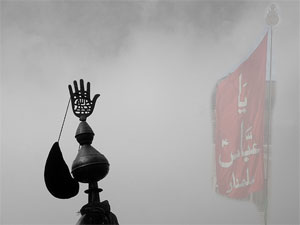
During the time of the Moharram Majlises, usually on the 8th, it has become a sort of custom to recite the events leading to the martyrdom of Hadhrat Abbas. And when the Alams (replica of the Banner or Standard of the Holy Prophet and the Holy Imams) are taken out, accompanied to the beating of breasts and heads by the mourners, one will notice a Mashk (a leather water-bag), usually made of metal in remembrance of Hazrat Abbas, who sacrificed his life trying to get water for the children of Imam Hussain, who were dying of thirst.

When Hadhrat Abbas rolled down from his horse after a mortal blow on his head, the Alam and the Mashk stayed linked together and never got separated. Hence one sees an Alam with a Maslik attached to it, and sometimes one also sees an arrow alongside it.

A Towering personality

Hadhrat Abbas was a towering and handsome personality. His dauntless courage, supreme confidence and unflinching loyalty earned him many titles. He was called, “Qamar-e-Bani Hashim” (Moon of the Hashimites), because of his imposing appearance. His remarkable horsemanship made him “Syed-ul-Forosan” (the chief of horsemen). His ability to lead people resulted in his being called “Rais-ul-Shujan” (the leader of the valiant), and the manner in which he sacrificed his life earned him the title of “Afzal-ul-Shohada” (the choicest of the martyrs) and “Saqqa” (water carrier), because he sacrificed his life in an effort to procure water for Imam Hussain’s children in the tragic battle a Kerbala. He fully lived up to his name Abbas, which in Arabic stands for Lion.

 References:

www.islamicoccasions.com

By: admin

The Aims and Objectives of Imam Hussain’s Stand

In: Ahlul-Bayt

What was the course of Imam Hussain’s (A) revolution?

What reasons prompted him to initiate such a great and unmatched upspring?

Did he intended to overthrow the Yazid regime? Did he wish to end the Umayyid dynasty?

These and such other questions keep cropping in the mind and everyone wants to know the satisfactory replies, specially the mourner of Imam Hussain (A) are more eager in this regard.

When Imam Hussain (A) was preparing to leave on his longest journey, he bid adieu to the grave of his grandfather, the Holy Prophet (S.AW). Then he wrote a legacy addressing his brother Mohammed Bin Hanafiyyah in which he explained the aims and objectives of his uprising. We are quoting an extract from the same legacy hereunder. He wrote thus:

“And surely the aim of my stand is not inspired by vain exultation and it is also not for the quest of kingdom, Neither it is to cause dissension and corruption nor it is to wrong anybody unjustly.”

These sentences of Imam Hussain (A) are sufficient enough to beat all the criticisms and accusation leveled against him by the enemies of Islam and the enemies of Imam Hussain (A).) Now the question arises if these were not the motives of Imam’s uprising than why did he took stand? What were the aims of his uprising? Thus continued Imam Hussain (A)

“The purpose of my stand is the reformation of my grandfather’s nation. I intend to enjoin goodness and forbid evil. I want to emulate my grandfather, the Holy Prophet (S)and my father Alt Bin Abu Talib (A). Whosoever accepts me by accepting the truth, then Allah is higher than the truth. And whosoever rejects me then I will bear patiently until Allah adjudges between me and them and He is the best Judge.”

In this legacy the chief of martyrs has explained three purposes for his stand:

1. The reformation of his grandfather’s nation
2. Enjoining Good and Forbidding Evil
3. Renewal and Revival of the tradition of the Holy Prophet (S) and Imam Ali (A)

These purposes are not different than each other rather these are complementary to each other because, nation can be reformed only by means of bidding good and forbidding evil. The tradition and path of the Holy Prophet (S) and Imam Ali (A) is goodness and anything other than that is evil. Some facts are stated by Imam Husain (A) in his other sermons and letters but in other words. When he reached Mecca he wrote a letter to the people of Basra thus;

“I invite you towards the Book of Allah and the Sunnah of the Holy Prophet (S) because indeed Sunnah has been mutilated and hereby is revived. Whoever will accept my words, then I will guide him towards the straight path”. (Tarikhe-Tabari vol.7, pg.240)

In another letter to the people of Kufa he wrote thus:

“By God, Imam is the one who acts on the commands of the Book, deals with Justice, followed the truth and reserves his self for the pleasure of Allah.”

These words of Imam imply that only he can be an Imam who possesses these characteristics and the one who does not possess them cannot be an Imam. Hence Yazid Bin Muawiyah has had no right to the caliphate. When he reached at ‘Baiza’, a place near Karbala and was besieged by the contingent of Hur, then he addressed his men and the army of Hur in these words:

“The one who sees a tyrant King who is making unlawful as lawful, violating the pledge (of God), opposing the Sunnah of the Holy Prophet (S) ruling on the servant of Allah with sins and oppression. And by his words and actions does not oppose the King and does not strive to reform the circumstances, then it behooves Allah to hurl him into Hell along with the King.”

Then he continued about the Yazidi regime thus:

“They have shun the obedience of Allah and acted following Shaitan. They are instigating commotion and dismissing the divine laws. They are expending from the public exchequer for their selfish end and are changing the prohibited things to permissible thing.”

In the first sermon at Karbala he spoke thus:

“Can’t you see that the truth is not followed and the falsehood is not shunned.? In such circumstances a believer should desire to meet Allah. Surely I regard death as nothing but an honour and life with Oppressors as anything but disgrace.” Tarikhe-Tabari, vol.-7pg.300)

Nevertheless the unique and unparalleled revolution of Imam Hussain (A) which began in Rajab 60 AH. and apparently ended with the glorious martyrdom of Imam Hussain (A), his kith, kin and companions was not in vain. The purpose of this revolution was to revive and rejuvenate Islam (which was distorted and Yazidi regime wanted to annihilate it), and also to reform the nation of the Holy Prophet (S). Some of the Sunni Traditionalists have added a phrase of ‘and on the path of Khulafa Rashedeen’. It is an addition made in the reign of Umayyid dynasty because the term ‘Khulafa-Rashedeen’ was coined by the Historians and Scholastic Theologians of that time and this term was not in use at the time of Imam Hussain (A).

Moreover, Imam Hussain (A) was critical about the behavioural pattern of the caliphs, then how he could have desired to follow their paths?

Reference:

www.ashura.com

By: admin
kadhmain

Commemorating the Shahadat of Imam Musa al-Kadhim (A)

In: Ahlul-Bayt
Birth 7th Safar 128 AH in Abwa
Titles Al-Kadhim, Babul Hawaaij
Death 25th Rajab 183 AH Baghdad (Buried in Kadhmain)

kadhmainA glimpse at the Babul Hawaij – Imam Musa Al-Kadhim (A)
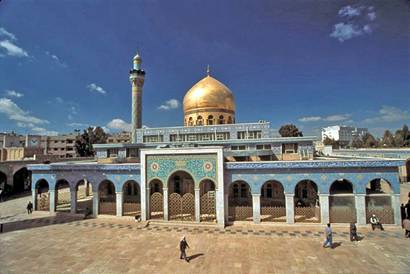
Imam Musal al-Kadhim (A) was such a blessed personality, that whosoever took his name as a wasila, they found that all their Dua were accepted. It is for this reason, that the people of Iraq referred to him as Baabul Hawaaij (The Door at which all their problems were answered).  It was widely known that Imam Musa Ibn Ja’afar had been given powers of healing. Once he was passing by a house and heard little children weeping. He enquired as to why they were crying. He was told that they were orphans and their mother had just died and now they had no one to look after them. He went inside the house, made two prostrations and prayed to God for her life. Moments later the woman stood up well and in good health. People who saw this and cried out, “Behold it is Jesus son of Mary.”

The Imam (A) who attracted the hearts of people

Despite the relatively brief contact he had with his followers, Imam al-Kazim (A) was held in very high esteem by the Muslims and his traditions are found in many Sunni works (Sunan Tirmidhi, Musnad ibn Hanbal, Sunan ibn Maja)in addition to Shi‟a works.

He is frequently compared to Imam Sajjad (A) in terms of his continuous acts of supplication and devotion – he is called al-Abd al-Salih. He not only transmitted hadith, he also interacted with Sufis – all Sufi lineages of course go back to Imam al-Sadiq (A) and nearly all to Imam Ali (A).

On an occasion when the Abbaside Caliph, Harun al-Rashid arrived at Medina, he went to pay a visitation to (the tomb of) the Prophet (S) The people went with him. Al-Rashid went forward to the tomb of the Apostle of God (S) and said: “Greetings to you, Apostle of God! Greetings to you, cousin”.  He was seeking to show his proud position over the others by that. But then the 7th Imam (A) went forward to the tomb and said: “Greetings to you, Apostle of God! Greetings to you, father.” (The expression on) al-Rashid’s face changed and the anger in it became transparently obvious.

In 793 Harun Rashid, went for the Hajj. He had Imam (A) arrested at night and sent to Basra, while also sending a decoy caravan elsewhere to fool the Shi‟a. After a year, Haroon instructed the governor in Basra to put the Imam (A) to death. The governor, was reluctant, saying that he had not observed any treasonable political activity on the part of the Imam (A); in fact while he had been in his care, he had observed the Imam (A) busy only in acts of devotion and scholarship. He further wrote that he was unwilling to bear the responsibility of detaining the Imam (A) any longer.

Haroon therefore removed the Imam (A) from Basra and had him taken to Baghdad, where he was imprisoned in a succession of different houses. Imam‟s (A) conduct throughout was such that he was able to incline the hearts of his various jailors towards him, to a point where Haroon had one of them publicly whipped for his supposed treachery to the caliphate.

The 7th Imam (A) setting the foundations for the great Uleamaa of today

The Holy Imam (A) has emphasized how important it is to keep close relation with the Ulemaa: “It is better to talk with an ‘Alim’ near a garbage heap than talking with an illiterate man sitting on a soft carpet”

From the time of the 6th Imam al-Sadiq (A), the Imams (A) appointed their representatives (wakil/wukala) in the lands where their followers existed. These agents collected and forwarded khums, organized the judicial systems (were the Hakim of the area), and acting as couriers of information to and from the Imam (A). Their positions later became very important as the Imams (A) were increasingly confined by the rulers, and truly the 7th Imam (A) was very often captured and sent to jail or kept under house arrest.

Imam Musa al-Kadhim (A)’s lineage was very prosperous – many past and contemporary scholars are Syed Al-Musawis, e.g  Syed Khui (R) and Imam Khomeini (R)

7th Imam (A)’s kindness and view of equality

One day 7th Imam, Imam Musa Al-Kadhim (A) was passing by the tent of a Nomad who was a black man. Imam Musa Al-Kadhim (A) went up to him and said “Salam Alaikum”, in a warm and friendly manner.

Upon leaving Imam Musa Al-Kadhim (A) said good-bye to him in a very kind manner with these words: “If there is anything I can do for you, I’m more than willing to do it”.

One of the followers of 7th Imam, Imam Musa Al-Kadhim (A) who saw this attitude said “Is it suitable for you, the son of the messenger of Allah, to sit and talk with a man of no reputation and make such an offer as: If you need me in any work, I’m more than willing to do it? Is it right for a man of great dignity to talk to a man like that?”

7th Imam, Imam Musa Al-Kadhim (A) replied, “This is one of Allah’s creatures. Allah has created all men equal. Besides, as a Muslim, he is our brother in faith. After all, life does not remain the same forever. One who needs help today may be the one who will be able to help us tomorrow when we’ll need help! If we don’t pay any attention to him today, one day when we may need him we will be embarrassed to ask him for help”.

One State official of Madina was a persistent source of harassment to the Imam. He even used abusive language regarding Imam Ali (A). But our 7th Imam always directed his followers not to retaliate in the same abusive manner. When his mal manner became too rude to be tolerated, Imam’s followers wanted to punish the rude man, but Imam Musa Al-Kadhim (A) would not allow them to. Imam Musa Al-Kadhim (A) told them that he himself would teach this man a lesson.  One day Imam Musa Al-Kadhim (A) rode out to the rude man’s farm where the man was working. When the man saw Imam Musa Al-Kadhim (A) he stopped working and put his hands on his hips, ready to be abusive again.

Imam Musa Al-Kadhim (A) dismounted went towards the man and greeted him with a friendly, smiling face. Imam Musa Al-Kadhim (A) then told him that he should not overwork himself and that the land he had was very good. He then asked him how much he was expecting to receive for the crop.

The farmer was amazed at Imam Musa Al-Kadhim (A) politeness and sincerity, he waited a little then said that he was expecting to get around 200 gold pieces. Imam Musa Al-Kadhim (A) took out a purse and gave it to the farmer telling him that in it was 300 gold pieces, more than the value of his crop. Imam Musa Al-Kadhim (A) told the man to take the money and also to keep the crop, and that he hoped the man would receive more for it.

The farmer faced with such kind behavior and good manner (Akhlaq), was very ashamed of himself and asked Imam Musa Al-Kadhim (A) for forgiveness.  After that when ever the man would see Imam Musa Al-Kadhim (A) he would greet him very politely. Imam Musa Al-Kadhim’s (A) friends were very surprised!

The last imprisonment and martyrdom of the Imam (A)

As to what may have led to his final imprisonment, we find that it is stated by Al-Fakhri that there were some of the relatives of Musa Ibn J’afar who were envious of him and carried false reports about him to Al-Rashid, saying, “The people paying him the Khums, or one fifth of the property, are accepting the Imamat and he is about to revolt against you”. They brought this report to Al-Rashid so frequently that it made him anxious and agitated. He gave the accuser some money to keep bringing him more information. But it is related through authentic sources that this relative of the Imam did not have the chance of enjoying that reward for espionage, for as soon as he reached Madinah, he suffered a serious illness and died from it. It was in that year that Al-Rashid went on the pilgrimage, and when he arrived in Madina, he arrested the Imam Musa Ibn Ja’afar, brought him to Baghdad and imprisoned him under the care of al-Sindi ibn Shahik. (Al-Fakhri-Ibnul Tiktika). This agrees with Majlisi’s comment in Bihar al Anwar that “Harun took him from Madina ten days from the end of the month of Shawwal 177 Hijiri. Then Harun set out for Makka and took the Imam with him when he returned to Basra and had him imprisoned with Issa. About one year later he was taken out of the Basran prison and taken to Baghdad. He was put in prison there under the watchful eye of the most cruel person named al-Sindi. Majlisi goes on to say that the Imam died in his prison and was buried in the cemetery of Qoraish on the south side of Baghdad.

Al-Fakhri adds,” Al-Rashid was at Rakka and sent orders that he should be put to death. They then brought a number of so called reputable men to Karkh to act as coroners and to testify publicly that the Imam died a natural death. The place he was buried was a cemetery of the Qoraish. But soon this place became the focus of pilgrimage on the grave of the Imam. A town grew around the grave yard. The name of the town became Kazimiya, the town of the Imam Kazim (A) A reputed school of theology was founded in this town which is still a source of learning for many students from all over the world.

Golden Sayings of the 7th Imam (A)

If there is a walnut in your hand and people say that it is a pearl, their saying will not benefit you in any way when you know that it is actually a walnut. And if there is a pearl in your hand and people say that it is a walnut, their saying will not harm you in any way when you know that it is actually a pearl.

Indeed cultivation and growth takes shape in a soft, even land and not in a rocky (barren) land. Likewise, wisdom grows and develops in a humble heart and not in a proud, vain and arrogant heart.

References:
Kitab al-Irshaad (Sheikh Mufid)
Story of the Holy Ka’aba And its People  (S.M.R. Shabbar)
www.ezsoftech.com/stories/imamkazim1.asp
MODULE: LIFE OF THE IMAMS (A) – HAWZA OF LONDON – 2008  (AJ/ HL/Jan 2008)


By: admin

Commemorating the Shahadat of Sayyida Zainab (A)

In: Ahlul-Bayt

Bibi Zainab (A):

“O Yazid! Practice any trick you can and do anything that you think would vanish Islam, but you should know that you can not eradicate our message, path and memory. You should know that our memory will never die.”

A year after imprisonment in the cells of Damascus, Yazid offered the choice of return back to Medina for the family and friends of Imam Husayn (A). Arrangements were made with velvet and beautifully decorated seats for the people, but Bibi Zainab (A) refused and ordered that they be covered in black, to show the passers-by that the contingent was in mourning.

The journey home went via Kerbala and upon arriving in Kerbala, the group were met with the presence of the companion of the Prophet (SAW), Jabir bin Abdullah al-Ansari who was the first visitor to the graves of the martyrs.

Upon return to Medina, it is reported that Bibi Zainab (A) looked so much older than before, despite the time being only about one a half years since she left Medina. Her hair had turned white and her back had become bent.

The final days of Bibi Zainab (A)’s life were spent in Medina, however towards the latter part of this period, she travelled towards the north to either Syria or Egypt. Both countries house a respected shrine for her, although amongst the pilgrims, the one in Damascus seems to be the more popular.

The events in Kerbala showed the true spirit of Bibi Zainab (A)’s character. Her steadfastness, knowledge, courage, compassion and many other traits, all poured out during the period in which the army of Imam Husayn (A) left Medina and returned back without the men folk.

The year 61 AH witnessed the revolution of Imam Husayn (A) and his near and dear ones. Naturally, with him was his sister Bibi Zainab (A) whose contribution to the revolution was profound especially after the battle had ended. She spearheaded the camp, leading all the ladies and children along the way, encouraging and giving hope despite there being little sign of any and at all times remembering her duty towards this revolution. History would witness that her actions were to spread the message across the oceans, over the deserts, through the valleys and over the mountains. For the message of Husayn (A) would last till the Final Day, no matter what obstacles came in the way.

It is interesting to ponder over the events that took place, but a glimpse of the speeches given by this honourable lady in the courts of Kufa and Damascus are even more awesome. The art of delivering a speech unprepared in the most eloquent classical Arabic mesmerised the crowds that had gathered. A part of the speech delivered in Kufa addressing the Kufians for their cowardly behaviour is herewith presented:

Woe unto you, O people of Kufa! Do you know whose heart you have burned, what a feat you have laboured, what blood you have shed, and what sanctity you have violated? You have done a monstrous deed, something for which the heavens are about to split asunder and so is the earth, and for which the mountains crumble. You have done something most uncanny, most defaced, duskiest, most horrible as much as the fill of the earth and of the sky. Do you wonder why the sky rains blood? Surely, the torment of the Hereafter is a greater chastisement, and you shall not be helped. Let no respite elate you, for rushing does not speed it up, nor does it fear loss of the opportunity for revenge. Your Lord is waiting in ambush to do so.”

Article contribution by Br Ali Bachoo

By: admin

Celebrating the Wiladat of Imam Muhammad al-Jawaad (A)

In: Ahlul-Bayt
Birth 10thRajab 195 AH in Madina
Titles At-Taqi, Al-Jawad
Death 29thDhulqa’da 220 AH in Baghdad. Buried in Kadhmain

One famous saying of the 9th Imam follows:
Some one asked, “was the Messenger of God Muhammad ibn Abdullah an illiterate.” Imam replied, “No, the Messenger of God knew 72 languages in which he could read, write and speak.

Some one asked the Imam about the Angels. What are they? The Imam replied, “They are the powers of God that regulate the Universe.

His Parents & Birth

He was the only son of Imam Ali ar-Ridha (A) The Holy Prophet (SAW) had said:
“My father be sacrificed on the mother of the 9th Imam who will be a pure and pious Nubian”.

Imam Musa Kadhim (AS) had told one of his companions that his daughter-in-law (Sayyidatinaa Sabika) would be one of the most pious of women and to give her his salaams.  She came from the same tribe as the Prophet’s wife – Mary Copt who bore the Prophet his son Ibrahim (died in infancy).

Imam Muhammad Taqi (A) was born when his father was 45 years old.  Till then Imam Ali ar-Ridha (A) had constantly been taunted that he had no children.  When the 9thImam was born, a brother of Imam Ali Ridha (A) was angry because he would lose out in inheriting the Imam’s property and in his jealousy spread a rumour that Imam Ali Ridha (A) was not the father.  He was eventually proved wrong by a person who could tell parentage. (NB: Same sort of accusation was made on Mary Copt about Ibrahim during the Prophet’s time.)

Childhood
The 9thImam was 5 years old when his father was called to Baghdad by Mamun Rashid to be his ‘heir apparent’.  When Imam Ali ar-Ridha (A) was leaving he saw his son putting sand in his hair.  He asked why and the young Imam replied that this was what an orphan did.

His titles, life & works
He became an Imam at the age of 9. Mamun Rashid thought that as all the rulers before him had fought with (oppressed) the Imams and their schemes had backfired he would try to buy (bribe) the Imams.  He tried to make the 8th Imam his heir apparent and give him power and wealth but that too backfired.

He now tried to use power and wealth with the 9thImam again but from a much younger age thinking that he would be able to influence him.  His main purpose was also to make sure that the 12th Imam (whom he knew would bring justice to the world) would be from his progeny and therefore intended to give his daughter Ummul Fadhl to the Imam for a wife.
Mamun still continued oppressing the family and followers of the Ahlulbayt.

Mamun called the young Imam to Baghdad from Madina and offered his daughter.  This infuriated his family (Banu Abbas).  To prove to them the excellence of Imam even at a young age he arranged a meeting between Imam and the most learned of men at that time – Yahya bin Athkam.

It was a big occasion with 900 other scholars present too.  Imam was first asked by Yahya: “What is the compensation (kaffara) for a person in Ehraam who hunted and killed his prey?”

Imam replied that there were many more details required before he could answer that question as the question was incomplete:
1. Did the Muhrim (one in Ehraam) hunt in the haram or outside?
2. Did the Muhrim know sharia or not?
3. Did he hunt intentionally or not?
4. Did he hunt for the first time or was this one of many times?
5. Was he free or a slave?
6. Was his prey a bird or an animal?
7. Was it big or small?
8. Had he hunted by day or by night?
9. Was he baligh or not?
10. Was he repentant or not?
11. Was his ehraam for Hajj or Umra?

Yahya was stunned.  He looked down and started sweating.
Mamun asked the young Imam to answer the question himself which he did and then Imam asked Yayha a question which he could not answer.

The Banu Abbas admitted defeat and Mamun took the opportunity to offer his daughter in marraige to Imam. Imam read his own Nika (the khutba of which is used today) with the Mahr of 500 dirhams.  Imam wrote a letter to Mamun that he would also give Ummul Fadhl Mahr from the wealth of Aakhira.  This was in the form of 10 duas which were for fulfilling any hajaat (desires) [Chain of narrators upto Prophet – Jibrail – Allah]* .  Thus his title Al-Jawad (the generous one)
* These duas are found in Mafatihul Jinaan

Imam lived for a year in Baghdad with Ummul Fadhl.  She was very disobedient to Imam.  When she found out that Imam had another wife (from the progeny of Ammar-e-Yasir) and that there was also children including Imam Muhammad Taqi (A)  she was jealous and angry realising that her father’s plan had failed.

She complained to her father who also realised that his plan, to keep the 12thImam in his progeny, had failed. He was enraged and in his rage he drank heavily and went to the 9thImam’s house and attacked Imam with a sword.  Both Ummul Fadhl and a servant saw the attack and believed Imam was dead.  Mamun on waking next morning realised the consequences of his attack and was thinking of arranging the disposal of Imam’s body when he saw Imam well without a scratch on him.  He was confused and asked Imam who showed him an amulet which is called Hirze Jawad. Imam told him it was from his grand mother Bibi Fatima Zahra (A) and kept the wearer safe from all except the angel of death.  Mamun asked Imam for it and Imam gave him one.

Now Mamun was scared and tried a new tactic.  He tried to deviate Imam by sending him beautiful girls and musicians.  When he realised nothing was working he let Imam return to Madina.

Imam used this time to prepare the masails of Taqleed and Ijtihaad in preparation for the 12th Imam knowing that both the 10th and the 11thImam would spend most of their lives in prison.  He also prepared the people of Madina teaching true Islam knowing that this would be the last time they would be able to receive guidance directly from an Imam for a long time.

Ummul Fadhl continuously complained of Imam to her father who sent her letters back.

Mamun died in 218 AH and was succeeded by his brother Mo’tasam Billah.  He openly announced that all Shias were not Muslims.  He said it was wajib for people to kill and prosecute Shias, and destroy property belonging to Shias . They would not be prosecuted.

Ummul Fadhl now started complaining to her uncle who was sympathetic to her.  Mo’tasam called Imam to Baghdad. He asked Imam to pass judgement of how to punish a thief. Imam said only fingers could be cut as the palms were for Allah (as in Qur’an – it is one of the wajib parts to touch the ground during sajda).  As this decision was contrary to the decision  of the other ‘Ulema’ it strengthened the position of the Shias.

References:

Imam Muhammad at-Taqi (A), Course Notes, Hujjat Workshop

By: admin
more-than-million-people-visit-kadhimiya-city

Imam Musa al-Kadhim (A) Day

In: Ahlul-Bayt

more-than-million-people-visit-kadhimiya-cityImam Musa al-Kadhim (A):

“The best ways to gain closeness to Allah, after knowing Him, are prayer, kindness to one’s parents, and giving up envy, vanity and pride.”

Birth 7th Safar 128 AH in Abwa
Titles Al-Kadhim, Babul Hawaaij
Death 25th Rajab 183 AH Baghdad (Buried in Kadhmain)

Childhood

He is one of the Imams whose miracles in childhood are reported extensively. Imam Ja’far As-Sadiq (A) repeatedly pointed out * Imam Musa Al-Kadhim (A) as his successor because he knew of the people who after his death would differ.
*The Ismailis say Ismail (Imams eldest son who died whilst Imam Ja’far Sadiq (A) was still alive) was the 7thImam. One of the 6th Imam’s other sons – Abdullah also claimed Imamate.

Yaqub Al-Saraaj visited the 6thImam once who told him to greet his son Musa who was a  week old in his cradle. Imam Musa replied to the salaam and told Yaqub to change his daughters name (Humayra) as it was a name not liked by Allah.

Safwan (a companion of the 6thImam) once saw the young Imam Musa teaching the lamb he was playing with to prostrate to Allah. Once when Imam was 5 years old, Abu Hanifa came to visit the 6thImam.  He asked Imam Musa (A):
“O son of the Prophet! What is your opinion about the deeds of man?  Does he do them on his own free will or does God make him do them?”
The 7th Imam replied:
“The doings of man can have three possibilities –
(i) God compels a man to do them whilst he is helpless.
(ii) Both God and man share the commitment.
(iii) Man does them alone.
If the first is true than God cannot punish man for sins he did not commit. If the second is true than too God cannot punish man for he is an equal partner. Then, we are naturally left with the third, that man is absolutely responsible for his own doings.”

His Titles

These were used to avoid using Imams name as the very mention of it would lead to arrest, torture, harassment and/or death.
Babul Hawaaij (Door of fulfilment of needs)
Even after his death people have their needs fulfilled and do not return empty handed from his shrine (Ask especially for cure of physical illnesses, especially eyes).
Kadhim (One who swallows his anger)
Imam Musa (A) lived in an era when the rulers were the cruellest ever. Their hatred for the Ahlul Bayt and their followers was intense. Imam’s followers were constantly harassed and tortured. The last 19 years of his life was spent in prison. Despite all these hardships, he was always patient spending entire nights in the worship of Allah. His character even converted the prison wardens towards him.

His Children

He had 19 sons and 18 daughters. The most famous of his sons is Imam Ali Ar-Ridha (A)  and the most famous of his daughters is Fatima Kubra known as Masuma Qum who is buried in Qum.

References:

Imam Musa Kadhim, Course Notes, Hujjat Workshop

By: admin
2 b

Commemorating the Shahadat of Imam Ali an-Naqi (A)

In: Ahlul-Bayt

2 b

Imam al-Hadi (A) reported from his fathers that:

Ameer al-Mumineen Ali ibn Abi Talib (A) has said that he (A) once heard the Messenger of Allah (SAW) saying: ‘When people shall be resurrected on the day of Judgement, a caller will call me: ‘O Messenger of Allah! Allah has permitted you to reward your lovers and the lovers of your progeny who have followed them for your sake; and opposed their enemies for your sake. You can reward them as you like’. I shall say: ‘My Lord! Paradise! Put them in whatever part of it You like. This is the praised estate, which You have promised’.” (Bihar al-Anwaar)

The period of Imamat of our 10th Imam coincided with the decline of the power of the Abbasid Empire. They were threatened by the Turks and had to move the Capital from Baghdad to Samarrah. He was only 6 years old when his father Imam Muhammad at-Taqi (A) was martyred in Baghdad when poisoned by Mu’tasim Billah Abbasi.

Our Imam lived in Madina for the remaining 8 years of the reign of Mu’tasim and 5 years of the reign of Wathiq Billah. It was when Mutawakkil became caliph in 236 AH  the Imam was called over to the Abbasid capital Baghdad. Mutawakkil, was the most cruel and deadly enemy of the Ahlulbayt (A), who tried to drown the Grave of Imam Hussain (A) in Kerbala by diverting the waters of the Eupheretes River. But by a miracle the river water encircled the grave and did not go over it in spite of the fact that the surrounding ground was higher. When the Caliph failed in his action of drowning the grave he ordered that the whole area should be turned into farmland but when horses failed to take the plough over the grave, he realised his folly. Eventually he left the hallowed ground as it was but as long as he lived he forbade any pilgrimage to the Shrine of Imam Hussain (A). History tells us that pilgrims to the grave of Sayyidush Shohada (A) did continue to go in spite of the danger to their lives. Indeed many were killed on their way to the Shrine but the enthusiasm to visit the grave never subsided.

It was during the reign of Mutawakkil that our 10th Imam was brought to the presence of the Caliph from Madina to Baghdad. Yakubi writes in his history of the time that once the raiding party of soldiers found the Imam on his prayer mat and took him away to the caliph in the same state. Mutawakkil was engaged in his nightly drinking and frolics and asked the Imam to join him. Imam declined replying, “ A liquor such as that was never yet combined with my flesh and blood”. The half drunk caliph asked the Imam to read some po. Imam said that he did not indulge in such habits. But when the caliph insisted, the Imam recited the following lines (Ibn Khalikan narrated the story word for word).

Protected by valiant warriors they passed the night on the summit of their mountains but these mountains did not protect them. After all their power and pomp they had to descend from their lofty fortresses to the custody of the tombs. O’what a dreadful change their graves had hardly received them when a voice heard exclaiming, “ Where are the thrones and the crowns and the robes of State? Where are now the faces of the delicate, which were shaded by veils and protected by curtains. To this the tomb replied. The worms are now revelling upon these faces. Long were these men eating and drinking, but now they are eaten by the worms in their turn.

Many wept listening to these words uttered by the Imam. The Caliph left the Imam alone for a while, but still kept him under house arrest. In the end Mutawakkil died in the hands of his protectors, the Turkish guards, and his son Muntasir became the next caliph.

Mutawakkil died in 250 AH and Muntasir Billah assumed the caliphate. He ruled only 6 months. On his death Musta’een was enthroned. But soon he was also beheaded and succeeded by Mu’ta’z Billah. All this time our 10th Imam was either in Madina, or called by the Caliph to Samarrah where he spent the last days of his life under house arrest.

Hardships Suffered by the Imam During This Period

Caliph Mu’tasim remained preoccupied with war against the Byzantinians and also with the troubles created by the Abbasids tribesmen in Baghdad. But he did not harrass the Imam who carried his responsibilities peacefully. After Mu’tasim, Wathiq Billah too, treated the Imam fairly. But later when he was succeeded by his brother Mutawakkil, son of Mu’tasim, the period of persecution and tortures began in full scale for the Imam and for all members of his family. This ruler exceeded all his predecessors in bearing animosity towards Ahlulbayt.

Our 10th Imam’s main occupation in Madina, whenever he was left in peace by the Caliphs in Baghdad, was to impart his knowledge to the people. He attracted pupils in large numbers from the provinces where adherents of Ahlulbayt were strongest, namely Iraq, Persia and Egypt. During the eight years of the Caliphate of Mu’tasim and throughout the period of Wathik we do not hear that the Imam was molested. One of the most famous traditions he is said to have related, that had been written in the Sahifa by the hand of Ali Ibn Abi Talib (A) at the direction of the Apostle of God, and inherited by the Imams from generation to generation is related.

It was that the Prophet had defined faith (Iman) as contained in the hearts of men, and that their works (A’amal) confirm it, whereas surrender (Islam) is what tongue expresses which validates the union.

Although the person of the Imam was not touched by the tyrannical caliphs for a while, there was always suspicions about his activities. Masudi narrates one such occasion when our Imam was called by Mutawakkil who was not happy about the methods of teachings in the schools in Madina. Mutawakkil asked the Imam a question. “What does a descendant of your father have to say in regard to Al-Abbas ibn Abdul Muttalib?” Imam answered, “What would a descendant of my father say O’Amir, in regard to a man whose sons required his people to obey, and who expected his sons to obey God.” Caliph was pleased with this reply and let the Imam go.”

And in the same connection Masudi quotes another incident, which Ibn Khalikan has incorporated in his description of our 10th Imam Ali Al-Hadi (A) “Secret information had been given to Mutawakkil that the Imam had a quantity of arms, books and other objects for the use of his followers concealed in his house, and being induced by malicious reports he was led to believe that the Imam aspired to the Empire. Once Mutawakkil sent some soldiers of the Turkish guard to break in on him when he least expected such a visit. They found him quite alone, locked up in his room, clothed in a hair shirt, his head covered with a woollen cloak and his face in the direction of Makka. He was reciting Verses of the Qur’an expressive of God’s promises and threats, and having no other carpet between him and the earth than sand and gravel. He was carried off in that attire, and brought in the depth of the night, before Mutawakkil. When the caliph asked his captors about the arms and ammunitions found they said, there was nothing in the house which presents a threat to the throne. The caliph was ashamed of his misdeeds and let the Imam go.

During the sixteen years of the Imamate, Imam al-Hadi (A) had become famous throughout the Islamic world. Those who loved to learn the teachings of Ahlulbayt always flocked around him. In the 4th year of Mutawakkil’s reign the Governor of Madina Abdallah ibn Hakim started harassing the Imam. He sent hostile reports against him to Baghdad. He wrote to the Caliph that the Imam was assembling lot of supporters here which could be a danger to the security of the State. Imam became aware of this animosity and in order to counteract, he wrote a letter to Mutawakkil explaining the personal enmity of the Governor of Madina against him. As a political step Mutawakkil was quick to dismiss the Governor.

At the same time he sent a regiment under the command of Yahya ibn Harthama who explained to the Imam in a friendly way that the caliph wished him to stay in Baghdad for a while. He can then come back to Madina. The Imam knew well the motives behind this request. He realised that the polite invitation meant his banishment from his ancestral city. But to refuse to go was equally impossible for it would have resulted in forcible departure. Leaving the sacred city was painful to him as it had been for his respected forefathers, i.e. Imam Hussain (A) in 60 AH, Imam Musa ibn Ja’afar in 170 AH and Imam Ali Al-Ridha in 200 AH and also of his father Imam Muhammad at-Taqi in 220 AH.

This type of harassment had almost become a heritage. Mutawakkil’s letter was respectful to the Imam and the military detachment which was sent to escort the Imam was actually a deceitful show. So when the Imam reached Samarrah and the Caliph was informed, he neither arranged for any reception no for his stay. He was ordered to be accommodated in the wilderness of the city with beggars. Although the Ahlulbayt as the descendants of the Prophet were gladly associated with the poor and the destitute, and they did not covet luxurious living, Mutawakkil meant to insult the Imam. The Caliph handed him over to the custody of his secretary Razaqi and prohibited his meeting with others. It was almost a house arrest for the Imam.

It has been seen during the imprisonment of Imam Musa ibn Ja’afar (A) that his moral charm had softened the cruel hearted guards attitudes towards the Imam. In the same way Razaqi was also impressed by the greatness of the Imam Ali Naqi (A) and began to provide for his comfort. This leniency could not remain hidden from Mutawakkil who transferred the Imam to the custody of Sa’id, a cruel and ruthless man in whose imprisonment he spent twelve years. In spite of all the hardships he had to suffer there, the Imam passed his time in Ibadah. He prayed during the night and fasted during the day. Although confined within the four walls of the house in Samarrah, his fame spread rapidly throughout the Provinces of Iraq. Every household in the city of Samarrah seemed to know the whereabouts of the Imam and somehow they got knowledge of Islam and of Ahlulbayt from him.

As stated, Imam Ali an-Naqi (A) had built a house in Samarrah and did not go back to Madina either of his own free will or under the orders of these rulers. Due to his continued stay there and the lack of interference by the regime, the students, thirsty for knowledge, thronged around him to learn the teachings of Ahlulbayt. This alarmed Al-Mu’taz so much that he decided to end the sacred life of the Imam. He arranged through some courtiers to mix poison in his food. The Imam died soon after eating the poisonous food.

During imprisonment, the Imam had a grave dug up ready by the side of his prayer mat. Some visitors expressed concern or surprise. The Imam explained, “In order to remember my end I keep the grave before my eyes.”

The Imam died in Sarammara, the funeral was attended only by his son Imam Hasan al Askari who led the funeral prayers and arranged his burial, laying him to rest in his house.

References:

Story of the Holy Ka’aba And its People By S.M.R. Shabbar; Published by Muhammadi Trust of Great Britain

www.almujtaba.com

By: admin
imam_baqir_milad

Celebrating the Wiladat of Imam Muhammad al-Baqir (A)

In: Ahlul-Bayt

imam_baqir_milad

Birth

1st Rajab 57 AH in Madina 

Titles Baqir; Shakir; Haadi 
Death  7th Dhulhijjah 114 AH in Madina   


Indeed Allah has hidden three things in three others: His pleasure in His obedience. So do not belittle anything from His obedience since His pleasure may be in the same one. And Allah has concealed His wrath and anger in sins. So do not belittle any sin and consider it to be small. May be the wrath of Allah is in it. And He has concealed His friends and saints among the people. So do not look down upon anyone perhaps he may be the friend and saint of Allah.” (Bihar al-Anwaar)

His Birth

The blessed Imam was born on 1stRajab 57AH in Madina. His mother was Fatima, the daughter of Imam al-Hasan (A) and his father was Imam Ali bin Husain, Zain al-Abidin (A). He was unique amongst the Imams (A) in that both his paternal and maternal grandfathers were also Imams (A). He was present in Kerbala – he was only 4 years old, but remembered the events clearly. The insignia of his ring was “Al Izzatu Lillah” – All greatness/honour belongs to God. 1

According to many traditions, the name – which means expounder of sciences/knowledge was bestowed to him by the Prophet (S) in a tradition that goes back to Jabir bin Abdallah al-Ansari. Thus it is reported on the authority of Jabir in a direct tradition:

The Apostle of God (S), said to me: “You will live until you meet one of my children descended from al-Husain (A), called Muhammad, who will split wide open knowledge of religion. When you meet him, recite my greeting to him.” 2

Imam al-Baqir (A) himself reported:
I visited Jabir bin ‘Abd Allah al-Ansari, may God be pleased with him. I greeted him and he returned my greeting. Then he said to me: “Who are you?” That was after he had lost his sight. I answered, “Muhammad bin Ali bin al-Husain, peace be on them.”

“My young child, come close to me” he said. I went closer and he kissed my hand. Then he stooped down to my foot and kissed that. I turned away from him. Then he said to me: “The Apostle of God, may God bless him and his family, recites his greeting to you.”

“Peace and God’s mercy and blessings be on the Apostle of God” I said. “How is that, Jabir?” He told me: “One day I was with him when he said to me: “Jabir, perhaps you will live until you meet one of my descendants called Muhammad bin Ali bin al-Husayn, peace be on them, on whom God will bestow light and wisdom. Then recite to him my greetings.” 3

His Eminence amongst Scholars

Sunni and Shi’a sources describe Imam al-Baqir (A) as an eminent scholar. He is well known among the early fuqaha (jurists). His traditions appear in major works of hadith, and he is an authority for al-Tabari’s historical and exegetical works. In Sufi circles, too, Imam al-Baqir’s sayings are quoted. In Shi’a tradition (both Ithna’ashari and Ismaili), Imam al-Baqir is seen as the inaugurator of the legal and religious teachings that were further developed under his son and successor, Imam Ja’far al-Sadiq. Zaydi tradition, too, relied heavily on Imam al-Baqir through his disciple, Abul-Jarrud.

Imam al-Baqir lived at a time in history when religious doctrine was at the centre of both the intellectual and political life of the community. The late first and early second centuries of Islam were crucial times for establishing the foundation of the studies connected with the Qur’an; this involved interpretation of the Qur’an that relied, in turn, on the recollected actions and sayings of the Prophet Muhammad. Madina, where Imam al-Baqir resided, continued to be the centre of religious learning after the time of the Prophet, and it was in this cusp of history that Imam al-Baqir played a remarkably significant role.

Footnotes

1. al-Kafi, 2/473

2. Mufid, al-Irshad

3. Irshad

Article taken from course notes “The History of the Imams” by Sheikh Abbas Jaffer.

The Title: al-Baqir [al-Ulum] and the Greetings of the Prophet (S)


By: admin
mawled fatima zahra 1431 h by al roomi-d2y5839

Celebrating the Wiladat of Lady Fatima Zahra (A)

In: Ahlul-Bayt

mawled fatima zahra 1431 h by al roomi-d2y5839

Birth

20 Jamadi ul Thani
5 yrs before or after declaration of Prophethood

Titles

Zahra (radiant), Zakiyya (pure, chaste), Radhiyya (satisfied, content), Mardhiyyah (commendable, pleasing), Siddiqa (honest), Tahera (pure, chaste), Batul, Muhaddisa, Umme Abeeha (mother of her father), Ummul Aimma (mother of the 11 Imams)

Death 14 Jamadi ul Awwal 11 AH (according to most traditions)

Ibn ˋAbbas narrates from the Prophet (S) that he stated:

“My daughter Fatima is the foremost of all the women of the world, past and future. She is a portion of me, the light of my eyes, the fruit of my heart and a spirit that resides in my body… Be witness that that I have granted her followers amnesty from the fire of hell.” 1

Her Birth

According to Shaykh al-Kulayni, Fatima Zahra was born 5 years after the appointment of the Prophet to his mission (bi’that)2. Shaykh al-Mufid places her birth at 2 years after the bi’that3, and Shaykh al-Tusi4 has mentioned both dates. Accordingly, she lived for 8 or 11 years in Makka before she migrated to Madina, and according to Ya’qubi, two months after the hijra5, and according to Mas‟udi, in the second year of hijra, the Prophet married her to Ali b. Abu Talib.6

Sunni scholars usually mention that she was born 5 years before the bi‟that, in the year that the Quraysh rebuilt the Ka‟ba. Some of them, like Hakim Nishaburi, have also mentioned that she was born a year after the bi‟that, when the Prophet was 41 years old.7

Her Names

As reported by Abu Jaˋfar Qummi, her names include: Fatima, Batul, Hassaan, Hurrah, Sayyidah, ˋAdhra, Zahra, Hawra’, Mubarakah, Tahirah, Zakiyyah, Radhiyah, Mardhiyyah, Muhaddithah, Maryam al-Kubra, Siddiqah-ye Kubra8; and in the heavens she is called Nuriyyah and Haniyyah.9 It should be noted however, that by her names, we generally mean her titles and qualities. She was not necessarily called by all these names; some of them were her titles, while others reveal her qualities, and this is why they are more or fewer found in different traditions.

Her Characteristics

Fatima (A) was a radiant lady who resembled her father, the messenger of God, in her features, gait and manner. The mother of Anas bin Malik narrates that, “Her features were as radiant as the full moon or like the sun that parts the clouds and shines forth.”

It is narrated from the mother of the believers, Umm Salma, that: Fatima, the daughter of the Prophet (S), resembled him most closely in features and manner.10

Jabir bin ˋAbdallah Ansari used to say: Whenever we saw Fatima’s manner of walking, we were reminded of the manner of walking of the Prophet (S).11

It has also been reported from Ayisha: Whenever she came into his presence, the Prophet (S) would kiss her and make her sit in his own place.12

And she also said: I have not seen anyone resemble the Prophet (S) in his speech and conversation more than Fatima.13

Her Virtues

Ibn ˋAbbas narrates from Umm Salma that: “The Messenger of God married me and entrusted me with the upbringing and training of his daughter. But, I swear by God that I found her more courteous than me and more knowledgeable in every affair.”14

It is narrated from Zubayr that: “Whenever Fatima daughter of the Prophet (S) was mentioned in the presence of ˋAyisha, she would say, “I never met anyone more truthful than her except her father.”15

It has also been narrated by Fatima that: “When the verse 24/63 was revealed, I was embarrassed to call the Prophet (S), “father”, so I used to address him as, “O Messenger of God”, until he said to me, “O daughter, this verse has not been revealed for you and your family. You and I are as one. This verse was revealed for the faithless and haughty. Call me “father”, for I prefer it and God is more pleased with that.”16

Anas bin Malik narrates: “The Messenger of God (S) asked us, “What is most preferable for women?” We did not know what to reply, so ˋAli went to Fatima and asked her this question.

Fatima (A) said, “Why did you not answer that the it is most preferable for them that they do not see men and men do not see them.” ˋAli returned and related this reply to the Prophet (S). The Prophet (S) asked, “Who has taught you this?” He said, “Fatima.” The Prophet (S) stated, “She is a portion of me.”17

It has also been narrated that: “A blind man came to Fatima (A), daughter of the Messenger of God (S), and Fatima veiled herself from him. The Prophet (S) asked he why she had veiled herself from him, when he cannot see you. She replied, “O Messenger of God, he does not see me, but I can see him and (furthermore) he can smell fragrances.” The Prophet (S) stated, “I bear witness that you are a portion of me.”18

And finally, the Commander of the faithful (A), states about his married life, albeit brief, with Fatima (A): “I swear by God, until the day she departed this world, Fatima (A) never angered me, nor disobeyed me. Whenever I gazed at her, all sorrow and grief would leave my heart.”19

Her Position on the Day of Judgement

“The Prophet (S) stated, “On the day of judgement, a caller from the depths of the throne (ˋarsh) will call out, “O assembly of men, bow your heads and lower your eyes, until Fatima (A) daughter of the Prophet (S) passes across the path (sirat).” Then, accompanied by 70,000 heavenly maidens (huri), she will pass across the sirat as rapidly as lightning.”20

It has also been reported in many narrations that Fatima Zahra (A) will provide intercession for the friends of the progeny of Muhammad (S). Shaykh al-Saduq narrates from Ibn al-ˋAbbas who quoted the Prophet (S) as saying:

“It is as if I see that the day of judgement has come, and I can see my daughter F¡§ima seated on a radiant mount. She is surrounded on all four sides by 70,000 angels, while she leads the believing women of my community (ummah) into paradise. Every woman who would pray five times a day, fast in the month of Ramadhan, go for pilgrimage to the house of God, pay alms out of her wealth, and obey her husband will enter paradise by the intercession of my daughter, Fatima.

In addition to this, it has been reported in many narrations that before she enters heaven, Fatima (A) will claim justice from the killers of Husain (A). Shaykh al-Saduq reports from Amir al-Mu’mineen (A) that:

“The Prophet (S) said, “My daughter Fatima will come with a group of women. Then she will be told, “Enter the heaven.” She will say, “I will not enter until I know what was done to my son after me.” Then it will be said, “Look into the middle of the ranks of people.” When she will look, she will see Husain (A) standing, with no head on his body. She will give out a cry, which will be echoed by us, and all the angels. Then God’s wrath will be aroused and he will command a fire by the name of Hayhab, (which has been kindled for 100 years till it has turned black, and in which no joy is found and no sorrow is alleviated) to engulf the killers of Husain.21

Footnotes

  1. Bihar al-anwar, vol. 43, p. 172.
  2. Shaykh al-Kulayni; ‘Usul al-Kafi, 2/355.
  3. Iqbal al-A’mal, p. 623.
  4. Misbah al-Mutahajjid, p. 554.
  5. Shaykh ‘Azizallah Atardi; Musnad Fatima Zahra, hereafter called Musnad, quoting from al-Tarikh of Ya’qubi.
  6. Musnad, p. 219 quoting from Muruj al-Dhahab.
  7. Musnad, p. 14, quoting from Mustadrak al-Sahihain.
  8. Hassaan means devout and chaste; Hurrah means a free woman; Sayyidah means a leader of other women; ˋAdhra means pure; Radhiyah means a women who has reached the state of contentment; Mardhiyyah means a women who God is pleased with; Haniyah means a women who is abundantly kind-hearted and forgiving.
  9. Musnad; p 28, quoting from Manaqib of ibn Shahr al-Ashub.
  10. Musnad; p 30, tradition 31, quoting from Kashf al-Ghamma of Arbali.
  11. Musnad; p 30, tradition 29, quoting from Kashf al-Ghamma of Arbali.
  12. Musnad; p 32, tradition 34, quoting from Sunan Tirmidhi.
  13. Musnad; p 33, tradition 35, quoting from Mustadrak al-Sahihayn of Hakim Nishaburi.
  14. Musnad; p 14, tradition 1, quoting from Dalail al-Imama of Abu Jafar Tabarr.
  15. Musnad; p 34, tradition 37, quoting from Mustadrak al-Sahihain.
  16. Musnad; p 529, tradition 4, quoting from al-Manaqib of Ibn Maghazali.
  17. Musnad; p 336, tradition 9, narrated by Hafiz abu Naim in Hilyatu’l awliya’.
  18. Musnad; p 336, tradition 10, quoting from al-Manaqib of Ibn Maghazali.
  19. Bihar al-anwar, vol. 43, p. 134.
  20. Musnad; p 310, tradition 9, quoting from Dalil al-Imamah of Tabari
  21. Musnad; p 147, tradition 7, quoting from Iqab al-Amaal.

Article contribution by Sheikh Abbas Jaffer

By: admin