Sakina was Imaam Husayn’s most beloved child. Our Imaam was often heard to say, “A house without Sakina would not be worth living in!” She always had a sweet and cheerful smile and a very friendly nature. Other children sought her company as much as the grown ups did. She was very generous and always shared whatever she had with others.
There was a special bond between Hazrat Abbas and Sakina. He loved her more than he did his own children. If Sakina requested for anything, Abbas would not rest until he satisfied her request. There was nothing that Abbas would not do to make Sakina happy.
During the journey from Madina to Mecca and then Mecca to Karbala’, Abbas was often seen riding up to the mehmil in which Sakina sat to make sure that she had everything she wanted. Sakina loved her uncle just as much. While in Madina she would, several times a day, visit the house in which Hazrat Abbas lived with his family and his mother, Ummul Baneen.
Like any other four-five year old when Sakina went to bed at night she wanted to spend some time with her father. Imaam Husayn would tell her stories of the prophets and of the battles fought by her grand-father Ali. She would rest her head on her father’s chest and Husayn would not move from her until she fell asleep. When from the second of Muharram the armies of Yazid began to gather at Karbala’, Husayn said to his sister Zainab, “The time has come for you to get Sakina used to going to sleep without my being there!” Sakina would follow her father at night and Husayn had to gently take her to Zainab or Rubaab.
At Karbala’ when from the seventh Muharram water became scarce Sakina shared whatever little water she had with other children. When soon there was no water at all, the thirsty children would look at Sakina hopefully, and because she could not help them she would have tears in her eyes. Sakina’s lips were parched with thirst.
On the Ashura day, she gave her Mashk to Hazrat Abbas. He went to get water for her. The children gathered round Sakina with their little cups, knowing that as soon as Hazrat Abbas brought any water, Sakina would first make sure that they had some before taking any herself. When Sakina saw Imaam Husayn bringing the blood drenched ‘alam she knew that her uncle Abbas had been killed. From that day on Sakina never complained of thirst.
Then came the time when the earth shook and Sakina became an orphan! But even then she always thought of the others first. She would console her mother on the death of Ali Asghar and when she saw any other lady or child weeping Sakina would put her little arms around her.
Yes Sakina never again asked anyone for water. Bibi Zainab would persuade her to take a few sips, but she herself would never ask for water or complain of thirst!!!!
From the time when Imaam Husayn fell in the battle field, Sakina forgot to smile! Kufa saw her as a sombre little girl lost in thought. Quite often she would sit up at night. When asked if she wanted anything, she would say, “I just heard a baby cry? Is it Asghar? He must be calling out for me!”
Knowing that her weeping upset her mother, Sakina would cry silently and quickly wipe away her tears! In the prison in Shaam she would stare at the flock of birds flying to their nests at sunset and innocently ask Bibi Zainab, “Will Sakina be going home like those birds flying to their homes?”
Then one dreadful night Sakina went to bed on the cold floor of the prison. For a long time she stared into the darkness! The time for the morning prayers came. Sakina was still lying with her eyes wide open. Her mother called out: “Wake up, Sakina! Wake up, it is time for prayers, my child!” There was only the painful silence! Our fourth Imaam walked up to where Sakina lay. He put his hand on her forehead. It was cold! He put his hand near the mouth and the nose. Sakina had stopped breathing. In between sobs Imaam Zain ul ‘Abideen said: “inna lil-Lahi wa inna ilay-hi raja’uun.”
How was Sakina buried? Zainab held the still child as Imaam Zain ul ‘Abideen dug a grave in the cell. As the grave was being filled up after the burial the mother let out a scream! How could anyone console Bibi Rubaab? What could they say? They huddled around her, and the prison walls began to shake with the cry: “ya Sakina, ya madhloomah!!” Bibi Rubaab put her cheek on Sakina’s grave and cried out: “Speak to me, Sakina! Only a word, my child! Speak to me!!”
As the sun was setting in the horizon, the soldiers rushed to Imam Hussain’s camp in search of booty. They looted every tent. Every lady and every girl was stripped of her veil. Fatima’s daughters were left bareheaded. Sakina’s ear-rings were pulled off her ears, splitting her ear lobes. When the little girl pleaded for her veil to be left untouched, she was slapped.
Surely they would stop now? But they did not. They set fire to all the tents. Bibi Zainab (pbuh) was very distressed. She turned to Imam Zainul Abideen (pbuh) and said “You are our Imam now. Tell us what we should do now, should we stay in our tents and burn, or go out without our veils?” Imam Zainul Abideen (pbuh) told her that it was their religious duty to try and save their lives. Bibi Zainab (pbuh) gathered everyone and waited outside, while their tents burnt down. When the fire was out, they took shelter under one of the tents which had not been completely destroyed.
‘Humayd son of Muslim’ describes how he saw a little girl with her dress on fire, her ears bleeding, running from the scene of carnage. He says: “I ran after her. I took her by hand. Put out the fire in her dress. I wiped the blood off her ears.” She looked at me and said, “You seem like a kind person, are you a Muslim?” I told her I was. She thought a while and then said, “Can you please show me the way to Najaf?” I asked, “Why do you want to go to Najaf at this hour and in this state?” She said, “I want to go and complain to my Grandfather ‘Ali son of Abu Talib’ about how they killed my father.” Realizing that she was Hussain’s daughter Sakina, I took her back to her aunt Zainab (pbuh).
As the night descended, Bib Zainab gathered all the ladies and children, into one small space in between the gutted tents. Imam Zainul Abideen (pbuh) lay on the ground surrounded by these widows and orphans. There was no fire, no light. Only the moon cast its dull light.
‘Umar son of Saad’ asked Hurr’s widow to take some food and water to the ladies and the children. As she neared to where they were resting, Bibi Zainab (pbuh) recognized her. She stood up, went towards Hurr’s widow and offered her condolences for the death of Hurr. This gesture on the part of Zainab (pbuh), who had suffered so much, lost so many, and carrying so much grief in her heart, is a lesson in Islamic ethics which the world should never be allowed to forget. When Bib Zainab (pbuh) saw the bread and water she cried.
“Imam Hussain and his brave soldiers had died hungry and thirsty, and now the same people who martyred them were bringing bread and water to their widows and orphans.” She looked at the sky and prayed to God to give her courage. Zainab (pbuh) remembered the words of her brother to give water first to Sakina (pbuh). Zainab (pbuh) took the jug of water. She went to Sakina (pbuh) who had fallen into a fretful sleep.
Gently she stroked the girl’s disheveled hair. Sakina opened her eyes. Zainab (pbuh) said, “Here is some water, Sakina. Please drink a little. You have been thirsty for so long!” On hearing the word ‘water’ Sakina cried out hopefully, “Has my uncle Abbas come back?” When she was told that Hurr’s widow had brought the water, she got up, went to Hurr’s widow, thanked her and then asked Zainab: “Have you all drunk water?” Zainab shook her head as no. Sakina asked, “Why then do you ask me to drink water?” Zainab said, “Because, my dear, you are the youngest.” Sakina replied, “No! No! Ali Asgher is the youngest!” Sakina took the jug of water, ran towards where Ali Asgher lay buried, crying “Wa Asghera! Wa Asghera!”
This was how the homeless spent their night in Karbala. They had lost everything. Their men had died. Their children had been martyred. In this desolate desert fourth Imam, the women and the remaining children are huddled where only a few hours before had stood their camp. Abbas, Qasim and Ali Akbar had taken turns to guard the camp. Now Zainab and Kulthoom lay awake to make sure that Imam Zainul Abideen (pbuh) and the children were not attacked.
Suddenly, Bibi Zainab (pbuh) notices that Sakina (pbuh) has disappeared. She is alarmed. She looks around but Hussain’s darling daughter is not to be seen. Zainab (pbuh) slowly walks to the battlefield. She comes to where Abbas (pbuh) lay. “Abbas! Abbas! My dear brother, have you seen Sakina?” There is silence! She makes her way to where Hussain’s headless body lay. There, hugging her father, she finds Sakina, deep in sleep!
Attention of Bibi Zainab (pbuh) towards Imam Zainul Abideen (pbuh) during the Journey:
Imam SajjadThe night of calamity passed away and the ladies of Imam Hussain’s household were made captives the next day. They were made to wait in the hot sun while the enemy spent the rest of the day burying their own dead. They were made to mount saddle-less camels like common criminals. Imam Zainul Abideen (pbuh) was sent towards Kufa hands and feet clasped together in iron and wearing a barbed iron collar and made to walk barefoot on the hot desert sand, even though he was sick. The caravan passed through the battlefield where the bodies of the martyrs lay without shroud, mixed in dust and blood. It was here that Imam Zainul Abideen (pbuh) would have died of grief. He turned a pale yellow. Bibi Zainab (pbuh) consoled her nephew, “Be patient! What am I witnessing? You are the Imam of the time.” She reminded him of the tradition of Holy Prophet (pbuh) to Umm-e-Aiman which had explained the divine covenant.
At the front of the caravan the guards carried spears with the heads of Imam Hussain (pbuh) and his loved ones. The guards beat the prisoners, if they complained of anything. They did not even spare the youngest. Some children died along the way, and their bodies were left in the desert. By the time they reached Kufa they were bruised all over their bodies. When Bib Zainab (pbuh) saw Kufa, remembered the period of her father.
The caravan reached the court of Ubayd Allah son of Ziyad on the 12th of Muharram 61 Hijra. Ubayd Allah son of Ziyad, the governor of Kufa ordered the streets to be decorated, while there was a huge crowd on the streets of Kufa, jeering and making fun of the prisoners. There was commotion in the court of Kufa due to the oration of Bibi Zainab (pbuh). The speeches of Bibi Zainab (pbuh) where she commented on the faithlessness and cowardice of the Kufees made them cover their faces in their clothes in shame and misery.
But when some of the people saw the head of Imam Hussain (pbuh) on the spear they turned their heads and started to cry. They felt guilty that they allowed this to happen to Imam Hussain (pbuh) when this same Imam was ready to help them when they needed him. It was noon and the sun was blazing hot. The children were crying of hunger and thirst. As the caravan reached the Governor’s palace, Bibi Zainab (pbuh) faced the crowds and said “Do you know who your governor has killed? We are the Grandchildren of your Prophet Muhammad (pbuh). When your Governor killed the Prophet’s loved ones, the skies cried and the earth shook. Where were you then?” There was complete silence in the crowd. Some of the people realized their mistake and started to cry with shame. When ‘Umar son of Saad’ saw what was happening he quickly led the prisoners into the palace.
When Ubayd Allah son of Ziyad saw Imam Zainul Abideen (pbuh) in the palace he ordered him to be killed straight away. Bib Zainab (pbuh) ran in front of him and said “You will have to kill me first. How dare you sit on this throne which does not rightfully belong to you and insult us? Listen, O son of Ziyad we are the Grandchildren of the Prophet. You should be ashamed of yourself. You claim to follow the Prophet’s teachings, yet you have done everything to destroy his family.” Ubayd Allah son of Ziyad was surprised at how brave this lady was. He thought that after all that they had suffered; they would not have the strength to face him. More and more people started to realize that what Bib Zainab (pbuh) was saying was true. Ubayd Allah son of Ziyad ordered the prisoners to be taken to the prison next to the palace immediately. He told Shimr and Khooli, who were the leaders of this caravan, to make preparations to take the prisoners to Syria (Damascus) before they had a chance to speak out in public again.
The caravan of Bib Zainab (pbuh) left for Syria on the 13th of Muharram. Along the route, there were several altercations between the forces of Yazid and the supporters of Ahlul Bayt. As the caravan was leaving Kufa, people watched from the rooftops. Bib Zainab (pbuh) and other prisoners continued to tell the people about what had happened in Karbala. Many people started to speak out against Ubayd Allah son of Ziyad. On the journey the prisoners again suffered in the hands of the guards. When the caravan reached Syria, the prisoners had to wait in the hot sun while Shimr went to Yazid’s palace to announce their arrival. Yazid had declared that day as a day of celebration. Every corner of the city was decorated.
His mother was a very pious lady who spent her whole life fasting. The 10th Imam has said that his mother was one of the ladies of paradise and one of those from ‘Ahlul Haqq’ (people of truth).
He became an Imam at the age of 8 years. The khalifa wrote to the governor of Madina asking him to send the young Imam to a person called Junaydi for tutorage (the governor of Madina was threatened that if he did not do this than the people of Madina would be annihilated). Junaydi was a well known poet of that time and ‘anti – Ahlulbayt’ and was 80 years old. The Khalifa felt that if this was done than anything that the Imam did or said could be attributed to Junaydi i.e. it was taught to Imam by Junaydi. When Junaydi was once asked about the progress of his student he said :
“I am the student and he is the teacher. I now know what knowledge is. What I say is because of what I have been taught by Imam”. The Khalifa’s plan had failed yet again.
For a while the Khalifa left Imam in peace and freedom as they were engrossed in sorting out their own affairs (Removing the Iranians from power; adding the Turks and establishing power in Samarra). Imam used the time to open Madrasas and the atmosphere in the mosque of the Prophet was once again like in the time of the 6th Imam Ja’fer As-Sadiq (A)
He served the longest period of Imamate (besides the 12th Imam) – 34 years which can be divided into two parts – 17 years of freedom and 17 years under arrest.
In 234 AH came one of the most tyrannical rulers of the Abbasid Khilafate – Mutawakkil. He ruled with tyranny, killing, looting and terrorising especially those who were the followers of Ahlulbayt. Mutawakkil is also the one who ordered the desecration of the grave of Imam Husayn (A) wanting to remove Imam’s body and burn it (He did not succeed). He tried running water over the grave so no traces of the grave would remain but was unsuccessful. He ordered that all those wanting to visit Karbala would have their fingers cut off, then hand and feet cut then only be able to go if one other from the family was killed. Imam still asked Shias to visit Karbala. When Mutawakkil saw that all had failed and it did not discourage the visits than he banned all visits to Karbala completely.
Mutawakkil called Imam to Samarra. Imam was called under the pretext of respect and love towards him. Imam was aware of Mutawakkil’s intentions but went knowing that this would be an opportunity to show the Turks too what true Islam was. On arriving in Samarra the Turkish spies sent with Imam were amazed at Imam’s knowledge of the Turkish language when he had never visited the Turks before.
It was an opportunity for Imam to prepare the Mu’mineen in Samarra for ghaibat. Imam was put up in an Inn which was meant for beggars, destitute and criminals. From this Inn he was removed and put into the custody of an evil man called Zarraqui (who changed to be an avid supporter of Imam) and then a man called Seyyid.
Mutawakkil knew of the progress Imam had made in Madina in 14 years of spreading knowledge. Mutawakkil seeing that he could not humiliate Imam in any was he announced his arrival in Samarra as Ibnur Ridha (son of 8th Imam) and subjected him to things such as handing him a glass of wine in his hands in his court, asking him to sing, making him run in front of his (Mutawakkil’s) carriage..etc.
Imam Hasan Al-Askery (A) was placed under separate house arrest than his father at the young age of 5 years as Mutawakkil did not want the birth of the 12thImam. Whilst under house arrest Imam Ali An-Naqi (A) arranged for the coming of Sayyidatinaa Nargis to Samarra and for her to be well versed in Fiqh by his learned sister Sayyida Hakima.
Imam spent his life making the imminent ghaibat of the 12th Imam easier.
Soon after Mutawakkil was killed by his own son who could not withstand the behaviour of his father. After Mutawakkil’s death his son Muntasir was the successor and he lifted the restrictions of visiting Karbala. His rule was unlike his father’s tyranny but remained in power for only 6 months and died at the age of 25 years.
Then came Mustan Billah (Ahmed bin Mo’tasam) followed by Mo’taz Billah who continued his tyranny on Imam and his followers.
References
Imam Ali an-Naqi (A) – Hujjat Workshop Course notes
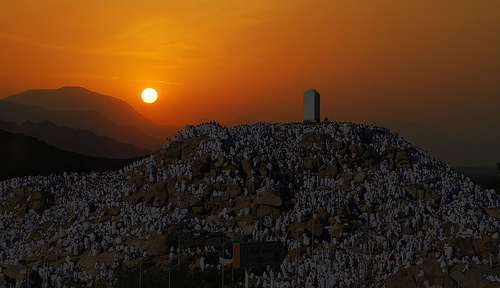
Arafat is a mountain or a granite hill, east of Mecca. It is also known as the Mount of Mercy (Jabal ar-Rahmah). The level area surrounding the hill is called the plains of Arafah. Arafat literally means Knowledge and Science. Arafat is the place where according to the Islamic narrations, the repentance of Adam was accepted by the God after his fall from heaven, Adam and Eve were united at the mount of Arafat, prayed together, asking for forgiveness and got married by archangel Gabriel. Arafat is a site for prayer, supplication and repentance but also acquiring proper recognition of God. Arafat which is marifat mean recognition
This is a day for those present on the plains of Arafah, who stand/sit in two piece of clothes, in scorching heat and ponder over just two facts, to whom they belong and where they are going
About two and half million Muslims will converge on the plains of Arafah for Waqafa (waiting) all afternoon for sunset. It is a vivid representation in all of humanity gathering at the end of Time. It is the day of reckoning where all pilgrims are repenting, supplicating, with hands high. Arafat is the place, where Prophet Muhammad gave his last sermon 14 centuries ago by proclaiming the equality of mankind, justice and freedom for all in an eloquent Human Rights manifesto. “All mankind is from Adam and Eve. An Arab has no superiority over non-Arab. A white has no superiority over a black nor does a black have any superiority over a white person, except by piety”. He also emphasized the women’s rights and demanded that husband treat their wives with kindness, respect and gentleness and that abusing the wife is immoral. The pilgrims ought to remember and recite the famous sermon on the mount Arafat is where he explicitly gave instructions to the Ummah in the following words: “I am leaving behind you two weighty things (the Saqalayn) the book of God – the Quran and my progeny, the Ahlul Bayt. Hold fast to them and you will never go astray.”
The plain of Arafat is the high point of the Hajj and Prophet Muhammad has said Arafat is the Hajj. While Imam Hussein inscribe an excellent supplication of Arafah, which is one of the famous in the Shiite Annals. Thirty days separate Arafah and Ashura. There exist many similarities and strong bondage between these two days as regard to the message. One clear link is that both of these days have a direct association with Imam Hussein –Doyen of Martyrs. The day of Arafah is all about journey in to the ocean of Gnosticism, which presents in the supplication and recommended to be recited on the day of Arafah.
If one takes a journey through this supplication with understanding and pondering will realize what divine lord and his lordship is all about and how dare one commit any sins. The most trembling state of this dua comes, when he utters the statements, whereby he say “O’ Allah, if you do full fill this one desire of mine, then all other needs which have fulfilled is of no benefit to me, and whatever you have not given me will not do any damage to me. And that one desire is that you relieve my neck from the fire of Hell”. This verse of this Dua, tell us that whether my worldly desires are fulfilled or not, it won’t make any difference if at the end I cannot free myself from the fire of hell.
My question is how this disciple of Dua-e-Arafah can be relaxed and comfortable, when he can witness such an injustice around the world. How can he a follower of Imam Hussein, an inheritor of Dua-e-Arafah forget the saying “Every day is Ashura and Every Land is Karbala”? Dua-e-Arafah is the gateway to Karbala for the Greatest Sacrifice – Zibe-Azeem.
Arafat is awe-inspiring great gathering you see millions shedding tears to gain salvation, seek Allah’s forgiveness (istighfar) and repentance (Tawbah) and making a firm resolution to avoid making the same mistakes. However, Hajj pilgrims ought to ponder on why the Prophet’s grandson Imam Hussein cut short the Hajj pilgrimage to leave the plains of Arafat for the plains of Karbala in Iraq. The pilgrims should contemplate this wise action that saved the sacred land of Mecca from being sullied with wanton bloodshed that assassin who had come in the garb of pilgrims intended, and how Abraham’s great descendant foiled their plot in order to preserve the sanctity of the Hajj and the Holy Ka’ba. This leads me to talk about Ashura, which fall exactly thirty days after the Great Sacrifice of Prophet Abraham of his son Ishmael. A month after the 10th of Zilhaj is the Day of Ashura and the name of Imam Hussein and Karbala are associated with the virtue of sacrifice. Also refried as the greatest sacrifice.
Ashura – Imam Hussein – The Great Sacrifice Everyday is Ashura and every Land is Karbala.
One of the Hajj rituals centers on the prophet Abraham test to sacrifice his son, which is known as the Greatest Sacrifice –Zibhe Azeem. However, Ishmael was saved twice, once when he was an infant when the spring of Zam Zam miraculously gushed out and second time when Archangel Gabriel by God’s command replaced him with a ram. According to the Quran a verse was revealed immediately to console Abraham say “O, Abraham! Of course thou hast faithfully fulfilled the dream, thou art of the truthful ones, but verily it is an open test, we have substituted it with a Greater sacrifice. We have transferred it to later generation” {Quran 37:105-108}. Hence, the honor was destined for Ishmael’s descendants, Imam Hussein, Ali Asgher and other martyrs of Karbala who were martyred in the state of thirst on the banks of the river Euphrates. It was on the 10th Muharram known as Ashura, 61 A.H (680 A.D) that Imam Hussein became a martyr under the most tragic and dreadful conditions ever chronicled in the annals of the civilized world. A nefarious ruler, Yazid, son of Muawiyah, carried the atrocious acts
The Prophet had told his companion Jabir bin Abdullah Ansari that he would live to see his great, great grandson who would have the same name as himself and would be granted light and wisdom. The Prophet asked Jabir to convey his greetings to the Imam.
Many years later Jabir did just that to the young Imam. By this time Jabir was very old man and had also lost his eyesight.
HIS TITLES
Al-Baqir Baqir means to split open. He is known as Al-Baqir for two reasons.
1. Baqir ul Ulum – One who split open knowledge. The Prophet had said “God sends a person in every century with the responsibility of revitalising and spreading the religion” (Mujaddid).
In the 1st century it was Imam Mohammed Al-Baqir (A) His Imamate was during a time when several threats faced Islam. (i)With the conquest of Iran and Rome, philosophy and new ideas came to Arabia. The simple minded Arabs got deviated and started ‘Innovations’-Kiyaas [this means they tried to use their own reasoning when they faced questions or problems (masail). (ii)The Khalifa’s were occupied in achieving more power, ‘looting’ of new countries but were reluctant at having new converts to Islam as this would stop jizya (tax paid by non-Muslims) to come to the treasuries. Islamic rule extended from Marrakesh to Mongolia. iii) Imam lived in a time of rulers who claimed to be the representatives of the Prophet (SAW) but their behaviour was as follows:
WALEED IBN ABDUL MALIK (86 AH) He poisoned the 4th Imam. Was drunk most of the time. Once sent a slave girl dressed in his clothes to lead fajr prayers.
SULAYMAN BIN ABDUL MALIK (96 AH) Was very fond of eating. Died of overeating.
UMAR BIN ABDUL AZIZ (99 AH) Mentioned later on
YAZID BIN ABDUL MALIK (101 AH) Allowed slave girl Hubaba to judge. When she died lived with her corpse as normal. Wouldn’t allow her to be buried.
HISHAM BIN ABDUL-MALIK (105 AH) Who poisoned 5th Imam.
2. For his worship (ibadat) Imam used to worship Allah with such devotion that from prostrations his forehead had split. This is another reason for his title Baqir.
HIS LIFE AND WORKS
Imam Mohammed Baqir’s (A) main mission and message was knowledge. He encouraged his followers to acquire a Muslim character and to have excellent morals-akhlaq, and disperse in the world for this was the best form of tableegh. He once told his companion Jabir bin Yazid Al-Jufi : “There is no Shia who has no taqwa and no obedience to Allah” ie. One cannot call oneself a Shia without these two qualities.
He also talked of 12 signs of a Shia : Humility, fear of Allah, trustworthiness, remembrance of Allah, fasts, prays salaa, is good to parents, good to neighbours, is responsible towards widows, orphans & children, fulfils his/her vows, pays back his/her debts, & recites the Qur’an.
When Umar bin Abdul Aziz became Khalifa in 99 A.H. he called Imam and asked him for some advice. Imam gave him 3 pieces of advice:- 1. Do not ever celebrate any occasion with excessive happiness which makes you forget ‘halal’ & ‘haraam’. 2. Never lose yourself in anger so that you forget ‘halal’ & ‘haraam’. 3 Never take away (usurp) anyone’s property.
On hearing the third piece of advice Umar bin Abdul Aziz returned to Imam Mohammed Al-Baqir (A) the garden of Fadak (it was this garden which Abu Bakr had snatched from Sayyida Fatima Zehra (A). His advisors tried to stop him but he did not listen to them [it was Umar bin Abdul Aziz who stopped the cursing of Imam Ali (A) in the mosques]
SUMMARY OF HIS LIFE WORKS (Imamat)
In an environment where conversion to Islam was discouraged and where the Khalifas were engrossed in the world and had no morals and were unjust; it was the light and character of Imam Mohammed Al-Baqir (A.S.) which kept the message of the true Islam alive. It was he who collected the saying of the Prophet and ‘Aimma in the form of books establishing the laws of Fiqh as we know them today.
HIS DEATH
In 114 AH Hisham bin Abdul Malik arranged with Zaid bin Hasan (an uncle of Imam) to deliver a poisoned saddle to Imam as a gift. Imam was thus poisoned and died after 3 days of illness. His son Imam Ja’fer As-Sadiq (A) buried him in Jannatul Baqee near Imam Hasan (A)
Additional Notes
Once a Christian asked the Imam about the Muslim belief that the fruits of Paradise are not reduced by eating and asked if such an example was available in the world. Imam replied that it was like a lamp. One may have a hundred thousand lamps lit from one lamp, but it would still not reduce the light of the original lamp. Before his death he called the people of Madina saying that it would be Imam Ja’fer As-Sadiq (A) who would give him ‘ghusl’ and ‘kafan’, thus informing them of the next Imam.
He had seven children: Ja’fer (6th Imam) (A); Abdullah; Ibrahim; Ubaydulla; Ali; Zaynab and Salma
The Imam gave much importance in having majlis for Imam Husayn (A); encouraging them as much as possible.
Mohammed bin Munkadir; a great ‘Shaykh’ of the time once saw Imam working in the fields under the hot sun. He went up to the Imam and told him if death came to him then (whilst working in the fields) what would he do as he was seeking worldly benefit. Imam answered that if death came to him then it was whilst be was obeying God; he would only fear if death came whilst he was disobeying Allah.
References:
Hujjat Workshop, Course Notes, Imam Muhammad Baqir (A)
Muslim ibn Aqeel used to lead the prayers in the Great Mosque of Kufa. When he led Salaat-ul-Maghrib, 30,000 people were following him. The support for Muslim ibn Aqeel in Kufa had become a major threat for Yazid and his governor, Ubaydallah ibn Ziyad. During evening prayers, people were sent from the court of the governor publicly announcing that anyone found supporting Muslim ibn Aqeel will be tortured and put to death.
When Muslim ibn Aqeel finished Salaat-ul-Maghrib, 30,000 reduced to 18 only. When Hazrat Muslim completed the Isha prayers and turned back, he found the mosque empty except for one person, only Hani Ibn Urwah, at whose house Muslim was staying as a guest.
Muslim ibn Aqeel had only one thing on his mind now, which was to inform his master Imam Husayn (AS) about the treachery and betrayal of the people of Kufa.
With Muslim completely isolated in Kufa, a ferocious battle took place – Muslim on one side, all alone, and over 500 soldiers on the other side, who were fully armed. Kufa had never seen such a battle before – Muslim defeated the army of 500. More troops were called and it was decided that it would be impossible to capture H. Muslim (AS) unless he is tricked. A pit was dug and covered with leaves. While fighting, Muslim fell into the pit and was captured.
Muslim was ordered to be taken to the roof of the palace to be executed and his body thrown to the ground. He was mercilessly killed on 9thof Dhul Hijjah, 60 AH , the day when Muslims were getting ready to celebrate the festivities of Eid al Hajj. Thus he became the first martyr of the epic battle of Karbala. He is buried in Kufa and thousands of people go annually to visit his grave and pay their respect.
The death of her mother had created a void in her life but her father filled it with his love and tenderness.
Muhammad, the Messenger of God, gave the utmost attention to the education and upbringing of his daughter. If he was the ideal for all men, his daughter had to be the ideal for all women, and she was. He made her the ideal of womanhood in Islam. She was the personification of devotion and obedience to the Creator, and she was the embodiment of all heavenly purity and saintliness. In character and personality, she bore a most striking resemblance to her father. Fatima, the daughter, was the image of Muhammad, the father.
By dint of obedience and service to God, Fatima Zahra rose to the highest rank in His sight, as attested by Al-Qur’an al-Majid. God bestowed the greatest honors upon her, and the Prophet of Islam, on his part, showed her the mark of greatest respect, one which he did not show to any other man or woman at any time in his life.
When Fatima grew up, two old companions – first one and then the other – asked her father for her hand in marriage. But he turned away from them in disgust, and said:
“This matter of the marriage of Fatima, my daughter, is in the hands of Allah Himself, and He alone will select a spouse for her”.
Allah duly made His selection. He selected His slave, Ali ibn Abi Talib, to be the spouse of the daughter of His most favorite slave, Muhammad Mustafa. He wished to see Fatima bint Muhammad and Ali ibn Abi Talib married.
Two months after the battle of Badr, i.e., in the month of Zilqa’ad (the 11th month) of 2 A.H., Ali called on Muhammad Mustafa, and said: “O Messenger of God, you have brought me up as your own child. You have overwhelmed me with your gifts, your generosity and your kindness. I owe you everything in my life. Now I seek one more kindness from you.”
The Apostle understood what Ali was trying to say. His face lighted up in a broad smile, and he bade Ali to wait for a few moments until he obtained his daughter’s answer. He entered the house, told Fatima that Ali was asking for her hand in marriage, and asked her what was her response. She kept quiet. He interpreted her silence as her assent, returned to Ali, informed him that his proposal was accepted, and told him to make preparations for the wedding.
On the last day of Zilqa’ad (the 11th month), Muhammad Mustafa, the Apostle of God, invited the Muhajireen and the Ansar, to attend a banquet, on the occasion of the marriage of his daughter. He was going to be their host. When all the guests arrived, and were seated, he obtained, once again, the formal consent of his daughter for her marriage with Ali ibn Abi Talib.
Muhammad Mustafa praised Allah, and thanked Him for all His mercies. He then read the sermon of marriage; declared Ali and Fatima husband and wife, and invoked the blessings of Allah upon both of them. All the guests congratulated the Apostle on this most auspicious occasion. After this ceremony, the guests feasted upon lamb meat, bread, date fruit and milk.
A few days later, i.e., in Zilhajj (the 12th month), Fatima Zahra had to bid farewell to her parental home so she could go to the house of her husband. Her father assisted her in riding his she-camel. Medina rang with the shouts of Allah-o-Akbar. Salman the Persian held the reins of the she-camel, and walked in front of it, as he recited Qur’an. The Apostle of God walked on one side of the she-camel, and Hamza, the Lion of God, on the other. All the young cavaliers of Banu Hashim rode as escorts of the bride, with gleaming swords held high. Behind them were the Muhajir and Ansar women, and behind them came the Muhajireen and the Ansar themselves. They were reciting hymns from Al-Qur’an al-Majid to the glory of God. The recitation of hymns was punctuated from time to time by thunderous shouts of Allah-o-Akbar.
This heavenly cavalcade made a circuit of the Great Mosque of Medina, and then halted at its destination – the house of the bridegroom – Ali ibn Abi Talib. Muhammad Mustafa aided his daughter in alighting from the she-camel. He held her hand, and symbolically placed it in the hand of her husband, and then, standing at the threshold of the house, said the following prayer:
“O Allah! I commend Fatima and Ali, Thy humble slaves, to Thy protection. Be Thou their Protector. Bless them. Be pleased with them, and bestow Thy boundless grace, mercy, and Thy best rewards upon them. Make their marriage fruitful, and make both of them steadfast in Thy love, and Thy service.”
It was a truly happy day in the life of Muhammad Mustafa. But how he must have wished that his beloved wife and friend, Khadija, were with him so both of them together could witness the wedding of their daughter.
A few days later, the Apostle of God called on his daughter, and asked her how she had found her husband. She said that she found him the best companion in giving devotion and obedience to God. Later, he asked Ali how he had found his wife, and he said that he found her the best companion in giving service to the Creator. The greatest moments of life for both husband and wife were those when they went into the Presence of their Lord, and were absorbed in praying to Him.
Between Ali and Fatima Zahra, there was total identity of interests. Both were brought up and educated by Muhammad Mustafa, the Messenger of God, and Khadija-tul-Kubra. Both, therefore, shared the ideals of their parents. Both put service to God ahead of everything else. There was absolutely no room for any disagreement between them. Their thoughts, words and deeds, all were “conditioned” by Al-Qur’an al-Majid. Their marriage therefore, was just as perfect and just as happy as the marriage of Muhammad and Khadija had been.
As noted above, Fatima’s greatest pleasure was to wait upon Allah. She spent most of her time in prayer. Her second greatest pleasure was to carry out her duties toward her family. God was pleased to bestow upon her four children – first two boys and then two girls. She ground grain in a mill which her father had given her as part of her dowry, and baked bread for them. Grinding grain day after day caused blisters to form on her hands but she never complained to her husband or to her father about them, and did all her housework cheerfully.
The household duties could become quite exacting for Fatima Zahra but she found happiness and strength in the remembrance of God. The Book of God was her constant companion. She forgot the drudgery of work as she read passages from that book. And when she put her children to sleep in the crib, she again read selections from the same book as “lullabies” to them. They grew up hearing Al-Qur’an al-Majid from their infancy. She etched the Word of God upon their young hearts. Through such “osmosis,” Qur’an and the children of Fatima Zahra became inseparable for all time.
In the same year, i.e., in 2 A.H., public prayers on the two holidays for the Muslims, viz., Eid-ul-Fitr and Eid-ul-Adha, were made a sunnat (meritorious) for them.
They conferred with one another and told him: ‘A person will be born in your kingdom who will wreck your power and destroy your influence.’ He asked if that person had actually been born or would be born in the near future. They told him that he was not yet born. Upon hearing that, Namrood ordered a ban on all marriages, separating men from women and ordered the killing of all new borns. Read More
Allah is All Powerful and All Knowing. His intentions come to be whenever He deems them to be. The mother of Ibrahim successfully concealed her pregnancy. She went out of the city limits and gave birth to her child in a cave. She stayed in that cave with her child until the senseless slaughter of the new borns had come to an end and the king’s own fear of his destruction had abated. By this time Ibrahim had grown up to be a tall and handsome lad. They returned to their ancestral home in the city of Ur.
His Intelligence, Cognition, and Rejection of Idolatry:
In those days people believed in the celestial bodies as their deities. One night, Ibrahim also selected the brightest of all the stars for his observation. By the morning its light faded and it disappeared. He thought that the most brilliant of the stars could not be the creator as it faded away in the brightness of another celestial body. Similarly he noted that the moon changed phases, and was but a shadow in front of the brightness of the sun. He concluded that the moon could not be the creator either. He pondered if the sun were the ultimate god, as he had also noted people bowing in subjugation to the sun. But the sun was out only for the duration of the day, and gave way to the stars and the moon at night. He reflected upon this phenomenon and concluded that the one who put these celestial bodies in their respective places has the supreme power over them and must be the God Almighty, even though He were not visible or physically tangible. He was pleased with this conclusion and enthusiastically began to tell people how wrong they all had been to ignore the obvious power behind their daily lives, the Supreme power of Allah. He invited them to give up their false gods and return to the truth.
Some laughed at his idea, some ignored him as he was only a youth “with little knowledge of life,” while others were offended and admonished him for his lack of respect for their gods.
They invited him to come to the annual festival and see for himself how they had decorated their gods along with fabulous offerings brought over from far and wide. Ibrahim excused himself and did not go to the festival. As the towns people had all gone to the fair grounds to indulge in their festivities, Ibrahim went to their temple, broke all their idols and left his axe hanging on the shoulder of the biggest of them all in the center of the temple.
Next day when people went to the temple and saw what had happened to their gods, they knew that Ibrahim had done it, since he had made no secret of his dislike of those idols. The village chief asked Ibrahim if he knew who had broken their idols. Ibrahim, pointing towards the big idol said, “Why don’t you ask him?” The chef said, “How could a stone idol do such a deed?” There upon Ibrahim said, “If the stone idol was incapable of doing it, or protect itself and the other idols, how could it be a god, the provider and the protectors ” They obviously had no answer to the logic of Ibrahim. However, they were not prepared to follow his path. They wanted him punished for being disrespectful to their gods. They sent a deputation to Namrood, their god-king for a judgement against Ibrahim.
Ibrahim was summoned to the court of Namrood to answer his charges and face the punishment.
When all the people had gathered in the court, Namrood arrived. All subjects bowed down to the ground for their total submission except for Ibrahim who remained upright and did not bow to the king-god. When asked why he refused to bow to him, Ibrahim replied that he submitted only to his God, The Creator, The Sustainer. This was an open insult to the king who commanded an absolute power over his subjects and claimed himself to be a god. By his act, Ibrahim had provoked the king’s wrath. However, surprised at the courage of Ibrahim, the king decided to question him.
Debate in the Court of Namrood on the existence of Allah
The king asked Ibrahim to explain to the entire audience who his god was. Ibrahim said that his God was one who gave life and who took it away. The king said that he did that every day!
Ibrahim said that his God brought forth the sun from the east. He asked the king that if he had the power, could he cause the sun to rise from the west! Clearly the king was unable to carry out such a feat.
The king then turned around and asked Ibrahim why he had broken all the idols in the temple. He gave the same reply to the king as he had given to the chief of the village before. The king said to Ibrahim that he knew that the idols did not talk and yet he kept on referring to the biggest of them to answer the question that actually pertained to him. Ibrahim said that since the king and all his subjects knew that idols did not talk why then they worshiped them as gods.
As there were no answers to the logic of Ibrahim the king ordered his courtiers to dig a large pit, light a wood fire and throw Ibrahim in it alive, to make an example so that nobody would again disobey or ridicule their god-king.
The Miraculous escape of Ibrahim from the fire
The pit was dug and a large fire was lit in it. When it was roaring with flames and the heat could be felt from a distance, Ibrahim was thrown in it. Ibrahim prayed to the true God, Allah, for His mercy in that hour of trial. By the Grace of Allah neither the fire nor the heat touched Ibrahim. He walked around as if in a garden and left the pit totally unharmed. This indeed was a miracle that convinced some of the onlookers who bowed to the true God and accepted the true religion of Allah and gave up idolatry.
Ibrahim left his ancestral city of Ur and migrated north to Haran where he stayed for a short period of time. Then he moved west to Kin’an (Canan in Torah), along with his wife Sarah and nephew Lut (Lot in Torah). After a while, Lut was appointed messenger by Allah to the people of Sidom and Gomorrah who lived north of Kin’an.
The Progeny of Ibrahim
Before finally settling in Kin’an, Ibrahim visited Egypt where the king gave him a maiden (according to some, his daughter) in marriage. Her name was Hajirah (Hager in Torah). Allah gave Ismail as the first born child to Ibrahim through his second wife Hajirah at a old age of eighty six years. Sarah was infertile and became jealous of Hajirah. Under instructions from Allah, Ibrahim took his son Ismail and his wife Hajirah from Kin’an and brought them down south in the land of Arabia where they were left to live for rest of their lives. Ismail grew up to be a handsome and tall young man who had many children and is popularly known as the patriarch of the Arabs.
Back in Kin’an, after a few years, Sarah who had grown old, and given up hope of ever bearing a child of her own, also conceived and bore a son to Ibrahim named Ishaq. It is worth noting here that Ibrahim had then turned ninety nine years of age. Ishaq was a great prophet of Allah in the land of Kin’an. He remained settled in Kin’an and had several prominent prophets amongst his progeny.
After the death of his wife Sarah, Ibrahim took another wife named Qutura from whom had many sons and daughters. These children of Ibrahim settled and populated the lands of Madain, Midyan and Saba.
The Trial of Ibrahim by Allah
One night Ibrahim saw in his dream that he had sacrificed his son Ismail to please Allah. He wondered over this dream and pondered over its meaning. He saw the same dream on three consecutive nights. He called his son Ismail and told him about his dreams. The son asked his father to do exactly what he had seen in his dreams, if that was the wish of the Creator Almighty, and that he would find him patient. Ibrahim tied his son just as he would tie a sacrificial lamb, and placed the knife on the throat of his son to carry out the sacrifice. The Sustainer of life and of all mankind sent the archangel Jibril (Gabrial) with salutations from Allah and told the father and the son that their belief in Allah and their resolve to give their most valued possession in life in His way had pleased Him greatly. Allah had sent a lamb to be sacrificed in place of Ismail. Ibrahim thanked the Lord for the acceptance of his service and returned home with humility and gratitude towards Allah. This act of Ibrahim has been perpetuated by Allah for ever, and is celebrated by Muslims all over the world every year when they sacrifice a lamb. This event is known as Eid-al-Adha.
The Construction of Ka’ba and Hajj
Ibrahim and his son Ismail built the Ka’ba and inserted the Black Stone in one of the comers of the building in accordance with the Will of Allah. The ritual of Hajj was initiated at that time and has continued to this day.
Solution to the question of Death and Resurrection
Once Ibrahim asked Allah how would He bring them to life again when the living had died and perished. Allah asked Ibrahim if he had doubts over that question. He said he had no doubt about the absolute powers of his Lord but he wanted to satisfy his curiosity over the mechanism of resurrection.
Allah instructed Ibrahim: ‘gather four birds, let them become familiar with you, then sacrifice them, mix their meat and scatter it on four hills across from one another. Then call the birds by their names, and they will come to you.’ Ibrahim did as instructed, and verily the same happened as predicted by the Supreme One, Allah. Thus Ibrahim solved the riddle of resurrection of the dead on the Day of Judgement. Allah will call His creation as He Wills, and they will all rise from their graves.
The Ritual of Circumcision
When Ibrahim turned ninety nine years of age, Allah ordained that he himself, his male progeny, and all believers be circumcised. The divine order was obeyed. It might be noted here that Ishaq was born to Ibrahim at that old age and after the ritual of circumcision. This ritual is practiced by the Muslims and the Jews, the followers of Ibrahim, and all those who recognize the hygienic advantages of circumcision.
The Death of Ibrahim
This great prophet and a friend of Allah, also known as the patriarch of all subsequent prophets, died at the age of one hundred and seventy five years.
Major Lessons from the Life of Ibrahim
1.Do not remain ignorant about religion,nor be stubborn about the old ways of our forefathers. Seek the truth. Accept it when discovered.
2. Do not associate any thing or any one with The Creator. Nothing can share with Him the glory of His Oneness.
3. Submit to Allah in total submission to enjoy His bounty and benevolence.
4. When it is difficult to practice your faith in safety and in peace, move to another place, for His territory is vast and His bounty limitless.
5. Whenever occasions arise requiring sacrifice to preserve or protect Faith, do not hesitate, for all we have, came from Him. We are independent owners of nothing in this world.
References: al Qur’an: Sura Baqra, ale Imran, Nisa’, An’am, Taubah, Lud, Yusuf, Ibrahim, Hajar, Nahl, Mariyam, Anmbiyaa, Hajj, Shu’raa, Ankaboot, Sa fat, Jinn, Zakhraf, Hadeed, Mumtahna, Zariyat, Najam, Taha. from www.al-huda.com
By ancient Arab custom, everyone was free to visit the Kaaba – unarmed. Also, by ancient custom, fighting of any kind was prohibited during the four sacred months of the year. One of these months was Zilqa’ada, the 11th month of the calendar.
The Muslims longed to see what for them was the House of God. Therefore, in Zilqa’ada of the sixth year after the Migration, their Prophet declared that he would visit Makkah to perform Umra or the Lesser Pilgrimage – unarmed but with his followers. With this intent, he left Medina in late February A.D. 628 with 1400 of his followers. They had taken camels and other animals for sacrifice but no weapons except their swords.
When this caravan of the pilgrims reached the outskirts of Makkah, the Prophet was informed that the idolaters would not allow him to enter the city, and that, they would use force to prevent him from doing so. This report caused great agitation among the Muslims. They halted near a well in a place called Hudaybiyya in the north of Makkah. The Prophet sent a message to the Quraysh that he wished only to make the customary seven circuits of the Kaaba, sacrifice the animals, and then return to Medina, with his followers. The Quraysh did not agree. Many other messages were sent but the Quraysh said that they would not admit the Muslims into Makkah.
Eventually, the Prophet ordered Umar bin al-Khattab to go to Makkah to explain to the idolaters the purpose of the visit of the Muslims, to assure them that they (the Muslims) had no intention of fighting against anyone, and to give them a pledge that after performing the rites of Umra they would leave Makkah immediately and would return to Medina.
But Umar refused to go. He said that there was no one in Makkah to protect him. He suggested, however, that the Prophet ought to send Uthman bin Affan with his message to Makkah since the idolaters would not do him any harm.
Sir William Muir
The first messenger from the Moslem camp to Mecca, a convert from the Beni Khozaa, the Coreish had seized and treated roughly; they maimed the Prophet’s camel on which he rode, and even threatened his life. But the feeling was now more pacific, and Mohammed desired Umar to proceed to Mecca as his ambassador. Umar excused himself on account of the personal enmity of the Coreish towards him; he had, moreover, no influential relatives in the city who could shield him from danger; and he pointed to Othman as a fitter envoy.
(The Life of Mohammed, 1877)
S. Margoliouth
Presently it was determined to send a representative to Mecca, but the consciousness that most of the Moslems were stained with Meccan blood, rendered the heroes of Islam unwilling to risk their lives on such an errand; even Omar, ordinarily so ready with his sword, hung back. At last the Prophet’s son-in-law, Othman s/o Affan, who had preferred nursing his wife to fighting at Badr, was sent as a grata persona.. (Mohammed and the Rise of Islam, 1931)
It is really strange that Umar was unwilling to risk his life by visiting Makkah. There was no risk involved for him because he was not one of those Muslims who were “stained with Meccan blood.” Since Umar had not killed any Makkan, he would be grata persona with the idolaters at all times. His refusal to obey the command of the Messenger of God, therefore, is incomprehensible.
Umar did not go to Makkah. Nevertheless, he solved the problem by producing his stand-in, Uthman bin Affan. Instead of him, therefore, Uthman was sent to Makkah to parley with the Quraysh. Like Umar himself, Uthman also was not stained with any pagan blood.
The idolaters welcomed Uthman and told him that he was free to perform the Umra. But he said that he alone could not perform Umra, and that they had to admit the Prophet and all the Muslims with him, into the city. This was not acceptable to the Quraysh, and it was reported that they had arrested him. It was even rumored that they had killed him.
When the rumors of Uthman’s execution reached the Prophet, he construed the action of the Quraysh as an ultimatum, and asked the Muslims to renew their pledge of fealty to him. All Muslims pledged their obedience to the Messenger of God regardless of the events which might take place thenceforth.
This pledge is called the “Pledge of Ridhwan” or the “Covenant of Fealty,” and those Muslims who gave it, are called the “Companions of the Tree,” because the Prophet of Islam stood under a tree as they filed past him renewing their oath of allegiance to him. Their numbers are given as 1400.
The resolution of the Muslims to dare the consequences appears to have put the Quraysh in a more reasonable frame of mind, as they realized that their intransigence could lead to unnecessary bloodshed. Uthman, it turned out, had not been killed as it had been rumored but had only been arrested, and now they released him – an act reflecting a change in their attitude. Also reflective of this change was the selection by them of one, Suhayl bin Amr, whom they sent to the camp of the Muslims to conclude a treaty with the Prophet of Islam. Suhayl was a man known to be a skillful but not an inflexible negotiator.
Suhayl arrived in Hudaybiyya and opened negotiations with Muhammad, the Messenger of God. After long and wearisome discussions and debate they succeeded in hammering out a treaty, the more important terms of which were as follows:
1. Muhammad and his followers would return to Medina without performing Umra (the Lesser Pilgrimage) of the current year.
2. There would be peace between the Muslims and the Quraysh for a period of ten years from the date of the signing of the treaty.
3. If any Makkan accepts Islam and seeks sanctuary with the Muslims in Medina, they would extradite him to Makkah. But if a Muslim, fleeing from Medina, seeks sanctuary with the pagans in Makkah, they would not extradite him.
4. All the tribes of Arabia would be free to enter into treaty relations with any party – the Muslims or the Quraysh.
5. The Muslims would visit Makkah to perform the pilgrimage in the following year but they would not stay in the city for more than three days, and the only weapons which they would be allowed to bring with them, would be their swords in the scabbards.
This treaty is called the Treaty of Hudaybiyya. It is the most important political document in the history of Islam. The secretary selected to indite its terms was Ali ibn Abi Talib.
When the Treaty of Hudaybiyya was being indited, an incident took place which throws a revealing sidelight upon the character of the various protagonists engaged in drafting its terms.
Dictating to Ali, the Prophet said: “Write, In the name of Allah, the Most Merciful, the Most Beneficent.” Suhayl, the Makkan envoy, at once raised objection, and said, “Do not write this. Instead, write, ‘In Thy name O Allah.'” The Prophet complied with this demand.
The Prophet next asked Ali to write: “This is a treaty of peace between Muhammad, the Messenger of God and the Quraysh…” Suhayl again objected, and said: “If we had acknowledged you a messenger of God, why would we be fighting against you? Therefore, do not write the words, ‘the Messenger of God,’ and write only your own name and the name of your father.”
The Prophet was agreeable to comply with this demand also but Ali had already written the words, “Muhammad, the Messenger of God,” and he refused to delete them. He said to his master: “This high rank has been bestowed upon you by Allah Himself, and I shall never delete the words ‘Messenger of Allah’ with my hand.” Thereupon, the Prophet took the pen in his own hand, and deleted the words which were offensive to the idolaters.
The Treaty of Hudaybiyya was signed on two copies, one for each party.
R.V.C. Bodley
The original of the Treaty of Hudaybiyya was retained by Mohammed while the duplicate was handed to Suheil for safekeeping in the archives of Mecca. (The Messenger – the Life of Mohammed, 1946)
In Makkah the leaders of the Quraysh hailed the Treaty of Hudaybiyya as a triumph of their diplomacy. They assumed that Muhammad had at last been outmaneuvered, and that the treaty was tantamount to, even if it was not a formal declaration of, “surrender.” The Quraysh gloated over what they fancied to be the surrender of the enemy but events were soon to show that they were wrong. Far from being a surrender, the Treaty of Hudaybiyya was one of the greatest triumphs of Islam.
Among the followers of the Prophet, however, the Treaty of Hudaybiyya was to produce some violent allergic reactions. Oddly, just like the pagans of Makkah, the “chauvinists” in the Muslim camp also equated it with “surrender.” They were led by Umar bin al-Khattab. He considered its terms “dishonorable,” and he was so much distressed by them that he turned to Abu Bakr for answers to his questions, and the following exchange took place between them:
Umar: Is he (Muhammad) or is he not the Messenger of God?
Abu Bakr: Yes. He is the Messenger of God.
Umar: Are we or are we not Muslims?
Abu Bakr: Yes, we are Muslims
Umar: If we are, then why are we surrendering to the pagans in a matter relating to our faith?
Abu Bakr: He is God’s Messenger, and you must not meddle in this matter.
But Umar’s defiance only escalated another notch after the admonition by Abu Bakr, and he went to see the Prophet himself. He later said: “I went into the presence of the Prophet, and asked him: ‘Are you not the Messenger of God?’ He answered, ‘Yes, I am.’ I again asked: ‘Are we Muslims not right, and are the polytheists not wrong?’ He replied: ‘Yes, that is so.’ I further asked: ‘Then why are we showing so much weakness to them? After all we have an army. Why are we making peace with them?’ He said: ‘I am the Messenger of God, and I do whatever He commands me to do.'”
But it appears that Umar was not satisfied even with the answers of the Prophet himself to his questions. The terms of the Treaty of Hudaybiyya had generated grave doubts in his mind, so he said: “I repeatedly questioned the Prophet regarding the terms of this treaty, and I had never before talked with him in this manner.”
Sir John Glubb
Many of the Muslims were disappointed at the outcome of Hudaybiyya, having anticipated a triumphant entry into Mecca. Umar ibn al-Khattab, as usual, voiced his indignation. ‘Is he not God’s Apostle and are we not Muslims and are they not polytheists?’ he demanded angrily from the quiet and faithful Abu Bakr. ‘Why not fight them; why compromise thus?’ (The Great Arab Conquests)
Tor Andre
Umar turned excitedly to Abu Bakr and other leaders who were near the Prophet to ascertain whether they really intended to submit to this humiliation (sic). He declared later that never before had he such doubts concerning Mohammed’s truthfulness, and if he had found merely a hundred like-minded men, he would have resigned from the umma of Islam. (Mohammed – the Man and his Faith)
Maxime Rodinson
Umar and some others were angry at the idea of treating with these pagans. The future caliph came to upbraid the Prophet. He declared later that if he had a hundred men on his side, he would have seceded. But Muhammad was immovable. (Muhammad,translated by Anne Carter)
R.V.C. Bodley
Most of the pilgrims, and Omar especially, were deeply mortified that Mohammed had given in to the Koreishites on practically every point. It seemed incredible to them that, after being brought all this way by their leader who had not been afraid to pursue an enemy which had defeated him, they should be halted outside their objective. It seemed even more incredible that he should humiliate himself before the Meccan envoy to the extent of neither calling his God by His rightful name nor using his own title, merely because the infidel had so demanded. Omar went as far as to ask: “Are you really God’s messenger?”
Omar went to see what the other Moslems felt. He found them much in the same frame of mind as he. For the first time since Islam had come into being, there were signs of revolt. (The Messenger – the Life of Mohammed)
Umar declared later that ever since he accepted Islam, he had never had such doubts about the truthfulness of Muhammad as he had on the day the Treaty of Hudaybiyya was signed.
This means that Umar was assailed by doubts from time to time about the truthfulness of Muhammad and his prophetic mission. He probably repressed them each time when they surfaced. But at the touchstone issue of the Treaty of Hudaybiyya, his chronic doubts erupted with such terrific force that he could not suppress them. Haunted by his doubts, he actually considered leaving the fraternity of Islam itself but could not find anyone in the camp who would give him moral support in his “enterprise.”
The traditional Sunni line has been that in showing defiance and insolence to Muhammad Mustafa, the Messenger of Allah (may Allah bless him and his Ahlul-Bait), Umar was prompted by his love of Islam. According to them, he loved Islam so much that he was “carried away.” Earlier, he had refused to obey the Prophet’s order to carry a message to the Quraysh in Makkah. That refusal, probably, was also prompted by the same love.
Those people who attribute Umar’s histrionics to his love for Islam, are, in fact, suggesting that he loved Islam more than Muhammad, the Prophet of Islam, himself did! Also, by his conduct, he was suggesting that God’s Messenger was wrong in seeking peace with the Quraysh but he himself was right, and that it was his duty to “correct” him (Muhammad Mustafa).
Only a day or so earlier, Umar had taken an oath to “obey the Messenger of God” through thick and thin, in peace and in war, in prosperity and in adversity. It was perhaps this pledge that impelled him to show himself more “royalist” than the “king” himself!
If it is a coincidence that both the Quraysh in Makkah, and Umar and his supporters in the Muslim camp, read in the Treaty of Hudaybiyya, the “surrender” of the Muslims, then it was truly remarkable. But if Umar’s saber-rattling that day had led to a showdown with the Quraysh, then one can surmise what part he would have played in it, judging by his own “track record” both before and after.
Writing about the Treaty of Hudaybiyya, Lt. General Sir John Glubb says in his book, The Life and Times of Mohammed:
The anxieties endured by the Muslims at Hudaybiyya are emphasized by the way in which those days of suspense remained etched on their memories. Many years after, when the Muslim armies had already built up a great empire, when veteran comrades spoke of the early days, the deepest respect was always shown to the men who had fought at Badr and to those who had taken the oath at Hudaybiyya – the two most tense crises of the rise of Islam. (The Life and Times of Mohammed)
There was no one among all the companions of Muhammad Mustafa who acquitted himself so honorably, both in the battle of Badr and at Hudaybiyya, and in fact, in all the critical moments in the history of Islam, as Ali ibn Abi Talib. In the past, he had shown himself to be the first in war; in Hudaybiyya everyone saw that he was also the first in peace. He had demonstrated many times in war that he had absolute trust in Muhammad and his mission, and now he was demonstrating in peace that there was nothing that could ever shake his faith in his master.
After the departure of the Makkan emissaries, the Prophet ordered the Muslims to shave their heads and to offer their animals as sacrifice, as rites of Umra. But he was shocked to notice that many of them were in a rebellious mood and did not want to obey his commands.
What actually had happened was that Umar had publicly defied the Apostle of God, and by his example, he had encouraged his followers also to do the same. The Apostle entered his tent, and told his wife that the Muslims were disobeying his orders. She said that if he ignored them, and performed the operations himself, they would follow him.
S. Margoliouth
The Moslems were sulkily silent when told by him (the Prophet) to shave their heads and offer their sacrifices. At last (by the advice of his wife, Umm Salamah), he performed the operations himself, and his followers did the same.
(Mohammed and the Rise of Islam)
His mission accomplished, Muhammad, the Messenger of God, left Hudaybiyya with the pilgrims, to return to Medina. He was still at seven days’ journey from Medina, when the following revelation came from Heaven:
Verily we have granted thee a manifest victory (Chapter 48; verse 1)
It was the Treaty of Hudaybiyya that the new revelation called “The Manifest Victory.”
Amin Dawidar, the Egyptian historian, writes in his book Pictures From the Life of the Prophet (Cairo, 1968, p. 465) that when the Messenger of God promulgated this latest revelation called “Victory,” Umar bin al-Khattab came to see him, and asked: “Is this what you call a Manifest Victory?” “Yes,” said the Messenger of God, “by Him in Whose hands is my life, this is the Manifest Victory.”
The Treaty of Hudaybiyya was truly the “Manifest Victory” as the unfolding drama of history was to reveal, notwithstanding the reservations about it of many Muslims in the camp of the Prophet.
Muhammad Mustafa was the Apostle of Peace. If he had yielded to the pressures of the “chauvinists” in his camp to use strong-arm methods, his whole mission would have been compromised, and the generations of the future would have indicted him for his love of “aggression.” But he resisted pressures to appeal to the arbitration of arms, and instead, appealed to the arbitration of peace, and achieved results which no military victory could have gained.
The Treaty of Hudaybiyya was a product of inspired statesmanship and political genius of the highest order. It brought immense advantages to Islam. Among them:
1. The Quraysh of Makkah acknowledged Muhammad as an equal. Heretofore, they had considered him a rebel and a fugitive from their vengeance.
2. By signing the treaty, the Quraysh gave tacit recognition to the nascent Islamic State of Medina.
3. Those Muslims who were in Makkah, concealed their faith from the idolaters for fear of persecution by them. But after the Treaty of Hudaybiyya, they began to practice Islam publicly.
4. Till 6 A.H., Muhammad, the Messenger of God, had been locked up in a ceaseless struggle with the pagan Arabs and the Jews, and there had been no opportunity for them to see Islam in action. After the Treaty of Hudaybiyya, they could “appraise” Islam for the first time. This “appraisal” led to the conversion of many of them, and Islam began to spread rapidly. The Treaty of Hudaybiyya opened the gates of proselytization.
5. Many Arab tribes, though still heathen, wanted to enter into treaty relations with the Muslims but felt inhibited by the opposition of the Quraysh. Now they were freed to make alliances with the Muslims.
6. The Treaty of Hudaybiyya is the best answer to those critics who allege that Islam was spread on the point of the sword. There is no better proof than this Treaty of the repudiation, by Muhammad, of war, as an instrument of policy, and of his genuine love of peace. The pagan Arabs were strongly influenced by the Qurayshite propaganda that Muhammad lusted for war. Now they could see with their own eyes that Muhammad retired to Medina without even a “quid pro quo,” even though he had an army with him, and even though he had defeated the Quraysh twice – in 624 and 627.
The Treaty of Hudaybiyya also points up the aversion of Qur’an for war. Before the treaty, the Muslims had won the two historic battles of Badr and Ahzab (Trench). If they had been defeated in either of them, Islam would have vanished for all time from the face of the earth. Victory in both of these battles guaranteed the physical survival of Islam. And yet, Al-Qur’an al-Majid didn’t call either of them a manifest victory. In the sight of Qur’an, among all the campaigns of Muhammad, the Treaty of Hudaybiyya alone was the Manifest Victory.
The Treaty of Hudaybiyya was the prelude to the victory of Islam over the forces of paganism, polytheism, idolatry, ignorance, injustice and exploitation. Umar bin al-Khattab had bridled at the third clause of the Treaty since it was not reciprocal; but it was precisely this clause that put the Quraysh on the defensive almost immediately, and they came a-begging to the Prophet to repeal it.
Eighteen months after the signing of the Treaty of Hudaybiyya, Muhammad, the Messenger of God, marched into Makkah, as a conqueror, and he was accompanied by ten thousand believers. The conquest of Makkah was a direct result of this Treaty.
Because of these results, many historians have rightly called the Treaty of Hudaybiyya the tour de force of Muhammad’s statesmanship.
Marmaduke Pickthall
There was dismay among the Muslims at these terms (the terms of the Treaty of Hudaybiyya). They asked one another: ‘Where is the victory that we were promised?’ It was during the return journey from Al-Hudeybiyah that the surah entitled Victory was revealed. This truce proved, in fact, to be the greatest victory that the Muslims had till then achieved. War had been a barrier between them and the idolaters, but now both partners met and talked together, and the new religion spread more rapidly. In the two years which elapsed between the signing of the truce and the fall of Mecca, the number of converts was greater than the total number of all previous converts. The Prophet traveled to Al-Hudeybiyah with 1400 men. Two years later, when the Meccans broke the truce, he marched against them with an army of 10,000. (Introduction to the translation of Holy Qur’an, 1975)
Two important principles of Islam can be seen in their application in the Treaty of Hudaybiyya, viz.
1. War must be eschewed at all costs unless it is absolutely inevitable. Solution of all problems must be sought and found through peaceful means, without, of course, compromising with the principles of Islam. To the pagans and to many Muslims, it had appeared that Muhammad, the Messenger of God, had given “carte blanche” to Suhayl, the Makkan emissary, so that he (Suhayl), in a sense, dictated his own terms. Notwithstanding such appearances, Muhammad had accepted those terms. Of course, there was no compromise with any principle. It was unthinkable that the Prophet of Islam would compromise with any principle of Islam
2. A Messenger of God does not have to defer to the opinions or wishes of his followers, or of the people in general. An overwhelming majority of the companions of Muhammad had been opposed to the signing of the Treaty of Hudaybiyya. But he ignored their opposition, and went ahead and signed it. He, in fact, did not even seek the advice of any of them in the matter. From beginning to end, he was guided, not by the wishes of the “people” or by the wishes of the “majority” of the people but only by the commandments of God, enshrined in His Book, specifically in the following verse:
So judge between them by what Allah hath revealed, and follow not their vain desires, diverging from the truth that hath come to thee… (Chapter 5; verse 51)
Extracted from:
A Restatement of the History of Islam and Muslims CE 570 to 661 by Sayed Ali Asgher Razwy
Al-Ridha, Zamin-e-Thamin, Gharib-ul-Ghuraba, Alim e Ale Muhammad
Death
29th Safar 203 AH Mashhad, Iran
A’bd al-Salaam Ibn Saaleh al-Hirawi states: I heard Imam Ridha (A) say: “May God have mercy on one who revives our mission!” I said to him (peace be upon him): How can one revive your mission? He (peace be upon him) said: “He should learn our teachings and impart them to the people, for if the people become aware of the beauty and charm of our words and teachings, they shall surely follow us.” (Ma’ani al-Akhbaar, pg. 180; U’yun Akbaar al-Reza, vol, 1, pg. 3)
He is Ali son of Musa son of Ja’ffar son of Muhammad son of Ali son of al-Husayn son of Ali son of Abu Talib (A), eighth in the series of the Imams belonging to the Ahl al-Bayt (A), in whose personalities all the standards of greatness have been personified; so, they became its most magnificent example and most genuine fountainhead.
His birthplace is Medina, and his resting place is Mashad, Iran.
Historians disagree a great deal about the year of his birth and even in determining the month as well, and they also disagree about determining the year and the month of his death.
He was born in Medina on Friday, or Thursday, Dhul-Hijja 11, or Dhul-Qi’da, or Rabi’ul-Awwal, of the Hijri year 148 or the year 153. He died on Friday, or Monday, near the end of the month of Safar, or the 17th of Safar, or Ramadan 21, or Jumada I 18, or Dhul-Qi’da 23, or the end of Dhul-Qi’da, of the year 202 or 203 or 206. In his ‘Uyoon Akhbar al-Rida, al-Saduq states: “What is accurate is that he died on the 13th of Ramadan, on a Friday, in the year 203.”
What is most likely is that his death took place in the year 203 as stated by al-Saduq. It is the same year in which al-Mamoon marched towards Iraq. To say that he died in 206 is not to agree with the truth because al-Mamoon marched towards Baghdad in the year 204, and the Imam died while he was heading in the same direction.
There is a great deal of dispute regarding the name of his mother and the number of his offspring and their names.
His life was characterised by a somber tragic stamp from its grievous beginning till its painful end. Bitterness seldom parted from his soul during the periods he lived, i.e. the reign of Harun al-Rashid and the beginning of the regime of Ma’mun, the latter’s son.
Imam Ali ar-Ridha was brought up under the holy guidance of his father for thirty-five years. His own insight and brilliance in religious matters combined with the excellent training and education given by his father made him unique in his spiritual leadership. Imam ar-Ridha was a living example of the piety of the great Prophet and the chivalry and generosity of Imam ‘Ali ibn Abi Talib.
Imam Musa al-Kadhim was well aware of the aggressive designs of the government in power against the Imamate and therefore, during his lifetime he declared Imam ar-Rida as his successor in the presence of hundred and seventy-one prominent religious divines and called upon his sons and his family to submit to him and refer to him in all matters after him. He also left behind a written document declaring the succession of Imam ar-Ridha duly signed and endorsed by not less than sixteen prominent persons. All these necessary steps were taken by the great Imam to avoid any confusion that may have arisen after his death.
Imam Musa al-Kadhim was poisoned while he was still in prison and passed away on 25th Rajab 183 AH, and on the same day Imam ar-Ridha was declared as the Eighth Imam of the Muslim world. Imam ar-Ridha had the great task before him of coming out with the correct interpretation of the Holy Qur’an; specially under the most unfavourable circumstances prevailing under the government of Harun ar-Rashid. Many belonging to the faith were imprisoned and those who were free and could not be jailed faced untold atrocities and sufferings. Imam ar-Rida, of course, stamped his impression upon his age by carrying on the mission of the Great Prophet in a peaceful manner even during the most chaotic periods, and it was mostly due to his efforts that the teachings of the Holy Prophet and his descendants became widespread.
Imam ar-Ridha had inherited great qualities of head and heart from his ancestors. He was a versatile person and had full command over many languages. He was described as the greatest sage, saint and scholar of the second century (AH). Once, on his way to Khurasan, when he (the Imam) was brought by force by the guards of Ma’mun from Medina, he arrived on horseback at Nayshabur. Myriads of people gathered around him and all roads were over crowded as they had come to meet and see their great Imam. Abu Dhar’ah ar-Razi and Muhammad ibn Aslam at-Tusi, the two great scholars of the day, stepped out of the crowd and begged the Imam to halt there for a moment so that the faithful may be able to hear his voice. They also requested the Imam to address the gathering. The Imam granted the request and in his brief address told the mammoth gathering the real interpretation of la ilaha illa Allah. Quoting Allah, he continued to say that the kalimah is the fortress of Allah and whoever entered the fortress saved himself from His wrath. He paused for a moment and continued that there were also a few conditions to entitle the entrance to the fortress and the greatest of all conditions was sincere and complete submission to the Imam of the day; and very boldly and frankly explained to the people that any disloyalty to the Prophet and his descendants would withdraw the right of the entrance to the fortress. The only way to earn Almighty Allah’s pleasure was to obey the Prophet and his progeny and that was the only path to salvation and immortality.
The above-mentioned incident speaks clearly of the great popularity of Imam ar-Rida, and the love, loyalty and respect the Muslims gave their beloved Imam. Ma’mun, the king during that time, was conscious of the fact that he would not survive for long if he also did not express his loyalty to the great leader and his intelligence department had made it clear to him that the Iranian people were truly and sincerely loyal to the Imam and he could only win them over if he also pretended to give respect and sympathetic consideration to our eighth Holy Imam.
Therefore, being the very shrewd person that he was, Ma’mun made a plan to invite Imam ar-Rida and to offer him the heirship to the throne. The Imam was summoned by a royal decree and was compelled, under the circumstances, to leave Medina – where he was living a quiet life – and present himself at the royal court of Ma’mun. On his arrival, Ma’mun showed him hospitality and great respect, then he said to him: “I want to rid myself of the caliphate and vest the office in you.” However the Holy Imam refused his offer. Ma’mun further repeated his offer in a letter saying: “If you refuse what I have offered you, then you must accept being the heir after me.” Yet again however, the Holy Imam refused his offer vigorously. However Ma’mun rejected the Imam’s refusal. Eventually Imam accepted his offer on the following conditions:
“I will agree to what you want of me as far as succession is concerned on condition that I do not command, nor order, nor give legal decisions, nor judge, nor appoint, nor dismiss, nor change anything from how it is at present.”
Ma’mun accepted all of the conditions.
On the day when Ma’mun ordered to make the pledge of allegiance Imam – ar-Ridha, one of the close associates of the Holy Imam who was present, narrates:
“On that day I was in front of him. He looked at me while I was feeling happy about what had happened. He signaled me to come closer. I went closer to him and he said so that no one else could hear, ‘Do not occupy your heart with this matter and do not be happy about it. It is something which will not be achieved.”
Therefore why did Ma’mun offer his leadership to our 8th Holy Imam?
Accrording to Allamah ash-Shibli, Ma’mun could not help but hold him in great esteem because of the Imam’s piety, wisdom, knowledge, modesty, decorum and personality. Therefore, he decided to nominate him a the rightful heir to the throne. Furthermore earlier in 200 AH Ma’mun had summoned the ‘Abbasids to his palace. Thirty-three thousand ‘Abbasids responded to the invitation and were entertained as royal guests. During their stay at the capital he very closely observed and noted their capabilities and eventually arrived at the conclusion that not one of them deserved to succeed him. He therefore spoke to them all in an assembly in 201 AH telling them in categorical terms that none of the ‘Abbasids deserved to succeed him. He demanded allegiance to Imam ar-Rida from the people in that very meeting and declared that royal robes would be green in future, the color which had the unique distinction of being that of the Imam’s dress. A Royal decree was published saying that Imam ar-Rida would succeed Ma’mun.
However even after the declaration of succession when there was every opportunity for the Imam to live a splendid worldly royal life, Imam ar-Ridha did not pay any heed to material comforts and devoted himself completely to imparting the true Islamic conception of the Prophet’ s teachings and the Holy Qur’an. He spent most of his time praying to God and serving the people. Taking full advantage of the concessions given to him by virtue of his elevated position in the royal court, he organized the majalis commemorating the martyrdom of the martyrs of Karbala’. These majalis were first held during the days of Imam Muhammad al-Baqir and Imam Ja’far as-Sadiq, but Imam ar-Rida gave the majalis a new impetus by encouraging those poets who wrote effective poems depicting the moral aspects of the tragedy and the suffering of Imam Husayn and his companions.
Ma’mun had been very scared of the growing popularity of the Imam and he had appointed him as his heir to the throne only for the fulfillment of his own most ambitious and sinister designs and getting the Imam’s endorsement to his tricky plans. However the Imam naturally refused to give his endorsement to any such plans which were against the teaching of Islam. Ma’mun therefore became very disappointed with him and as a result of the Imam’s growing popularity as well as to ensure his own (Mam’uns) survival, he decided to act in line with the old traditions of killing the Imam.
Seeking to do so in a subtle manner, he invited the Imam to dinner, and fed him poisoned grapes. The Imam died on 17th Safar 203 AH, he was buried in Mashad and his Grand Shrine speaks well for the great personality the Imam possessed. Myriads of followers visit his Shrine every year to pay their homage to this Imam.
Imam has promised the following to all those who visit his shrine in Mashad:
“By Allah I swear that this place – my shrine – is one of the Eden Gardens- he who visits me in the shrine is like visiting the shrine of the Holy Prophet (PBUH) and that of my ancestors and I will be his intercessor on the day of reckoning.”
Therefore, motivation for us all to visit – inshallah.
Sources: 1. www.al-islam.org 2. Hussaini Youth 3. Last quote – from terminal in Mashad Airport

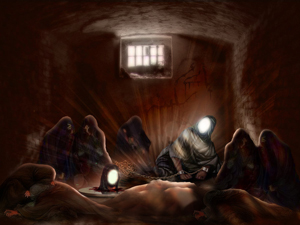
 By:
By: